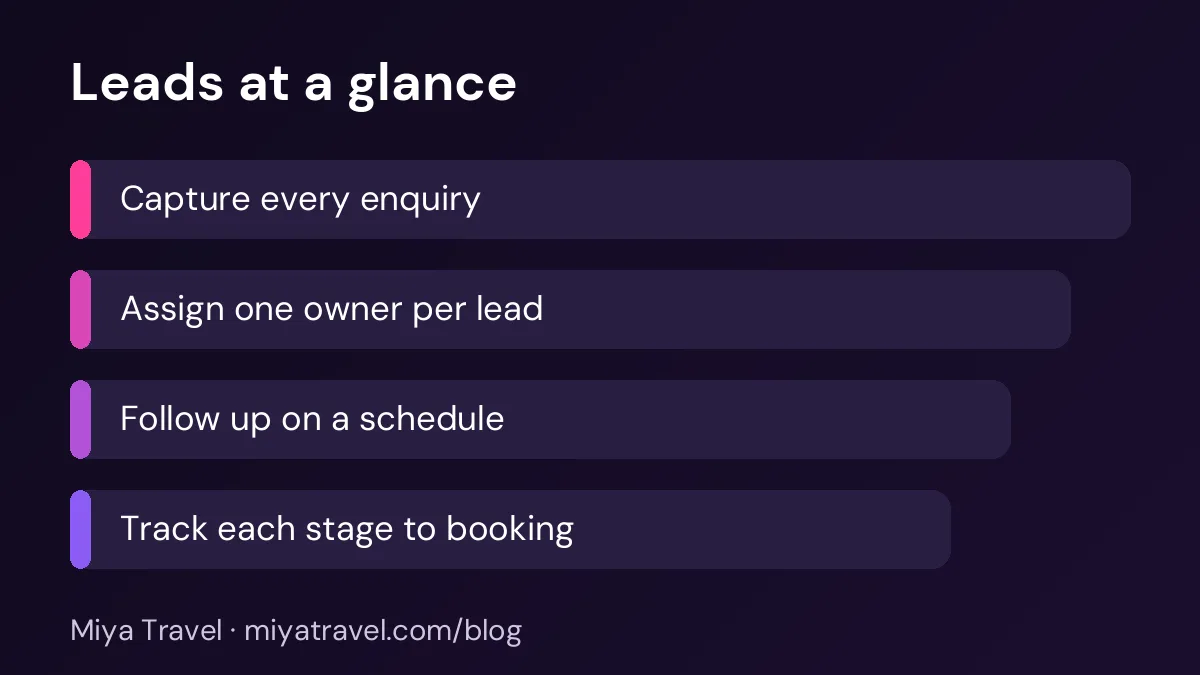
Lead management for travel agents means capturing every enquiry in one list, giving each lead an owner, following up on a fixed schedule and tracking each stage until the lead becomes a booking or is closed. A simple process beats a complicated tool that nobody updates.
Travel leads arrive from many places in a single day. A call comes in during lunch, a website form is filled at night, a WhatsApp message arrives while the agent is on a bus tour and a walk-in client asks for a quote at the counter. If nobody records these enquiries in one place, some leads are lost and others get two replies from two staff members. Lead management for travel agents solves this problem with a simple process that anyone on the team can follow.
This guide explains how to capture, assign, follow up and track travel leads. The steps work with a spreadsheet, a notebook or a dedicated tool. The tool only helps if the process is already clear.
Capture every enquiry in one list
The first rule is simple: every enquiry goes into one list. That includes calls, emails, website forms, social media messages, WhatsApp chats and walk-ins. If an enquiry is not in the list, it does not exist for the team.
Record the basics on the first contact: the client name, phone number, destination, travel month, number of travellers and budget range. Add the source, such as website, referral or repeat client. The source tells you later which channels bring the best leads.
Do not wait for a complete profile before you save the lead. A name and phone number are enough to start. You can add more details during the first call.
Give each lead one owner
Shared leads get lost. When two agents think the other one is handling the same client, nobody follows up. Assign one owner to every lead as soon as it arrives. The owner is responsible for the next action until the lead is won or closed.
Set a simple rule for assignment. You can assign by destination, by language, by region or by workload. What matters is that the rule is clear and that the owner can see the lead in their own list.
Use clear stages
Stages show where each lead is in the process. A practical set for travel agents is new, contacted, qualified, quoted, won and lost. A lead is new until someone calls. It is contacted after the first call. It is qualified when you know the destination, dates and budget. It is quoted when a quotation is sent, and it is won when the client pays or confirms.
Each stage should have a clear meaning. If "contacted" sometimes means a message was sent and sometimes means the client replied, the stage report will mislead you. Write down what each stage means and check it in the team meeting.
Follow up on a schedule
Most travel leads do not close on the first call. The client is comparing options, checking dates or waiting for family approval. Follow-up is where most bookings are won or lost.
A simple schedule works well. Call or message within an hour for a hot enquiry. Follow up the next day if there is no reply. Send a quotation within one working day after the qualifying call. Check in again after three days and again after a week. After that, close the lead or move it to a monthly update list.
Set the schedule in your tool or your calendar. A rule in your head is easy to forget during a busy week.
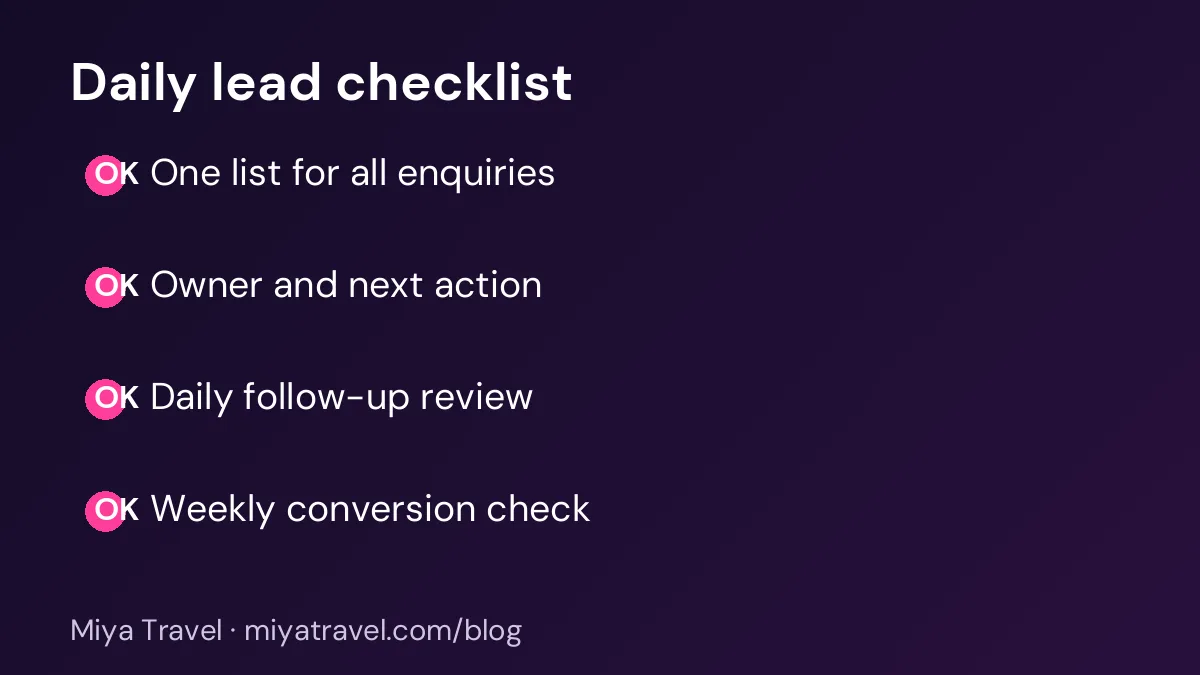
Review every open lead at the start of each day. Ask one question for each lead: what is the next action and when is it due? Leads without an answer need attention first.
Track what happens after the quotation
Many agents lose track of leads after the quotation is sent. The client sees the price, asks for a change and then goes quiet. Your process needs a rule for this stage. Log every revision and note the client's reason for the change. If the client asks for a lower price, record it. If the client chooses another agency, record the reason.
These notes show you why you win and lose. After a few months, the pattern is usually clear. Maybe quotations are too slow, or maybe the itinerary is not detailed enough. Fixing the process is more useful than lowering prices.
Measure the right numbers
Four numbers tell you most of what you need. The first is the number of new leads each week by source. The second is the percentage of leads that reach the quoted stage. The third is the percentage of quotations that become bookings. The fourth is the average time from first contact to quotation.
Review these four numbers every week, not every month. A drop in quoted leads this week shows up in bookings two or three weeks later. Weekly reviews let you act before the problem grows.
Handling a lead that goes quiet
Every agency has leads that stop replying halfway through the process. The client seemed interested, received a quotation and then disappeared. The temptation is to forget the lead, but a quiet client is often just busy. A structured approach gives these leads a fair chance without wasting staff time.
Start with a short message that adds value. Do not just ask "Did you see my quote?" Instead, mention one detail that matters to the client, such as a hotel near their preferred area or a date when the price changes. Wait three days, and if there is still no reply, try a call at a different time of day. If the second attempt also fails, move the lead to a monthly update list with a note of the last contact date.
Record the reason when a lead closes, even if the client never explains it. "No reply after three attempts" is useful information. Over a quarter, these notes show you whether quotations are too expensive, too late or too vague. That pattern is more valuable than any single lost lead.
Common mistakes
The first mistake is too many stages. A process with twelve stages is hard to update. Keep it to five or six.
The second mistake is no owner. A lead without an owner is a lead nobody will call.
The third mistake is ignoring old leads. Many agencies have hundreds of leads sitting in "contacted" with no follow-up for months. Close them or set a date to revisit them.
The fourth mistake is updating the list only at the end of the day. Data entered late is often wrong. Ask staff to update the status after each call or message.
How software helps the process
A lead tool does not replace the process. It makes the process easier to follow. Good software shows each owner their leads, sends reminders for follow-ups, links the quotation to the lead and shows the owner a summary of the pipeline.
Miya Travel includes leads with statuses, customer records, quotations and team workspaces. You can read the documentation on leads and quotations to see how the steps connect. Whatever tool you use, start with the process above first.
A week-one setup
On day one, decide your stages and your assignment rule. On day two, move all open enquiries into the list and assign an owner. On day three, set the follow-up schedule and brief the team. On days four and five, track every new lead and every quotation. On day six, review the numbers. On day seven, fix one thing in the process based on what you learned.
Repeat this cycle for a month. By then, your team will have a routine that does not depend on one person's memory.
Frequently asked questions
What is lead management for travel agents?
It is the process of capturing every travel enquiry, assigning an owner, following up on a schedule, tracking each stage and measuring the results until the lead becomes a booking or is closed.
How many stages should a travel lead have?
Five or six is enough for most agencies: new, contacted, qualified, quoted, won and lost. More stages make the list harder to update.
How fast should I respond to a travel enquiry?
Respond within an hour for a hot enquiry during working hours. A fast first reply often decides whether the client keeps talking to you.
Should I use a spreadsheet or software for leads?
A spreadsheet works for a very small team. Software becomes useful when several people share leads, when you need reminders or when you want reports by source and stage.
What is the most common reason travel leads are lost?
Slow follow-up after the first enquiry and no clear owner. Fix these two points before you change anything else.