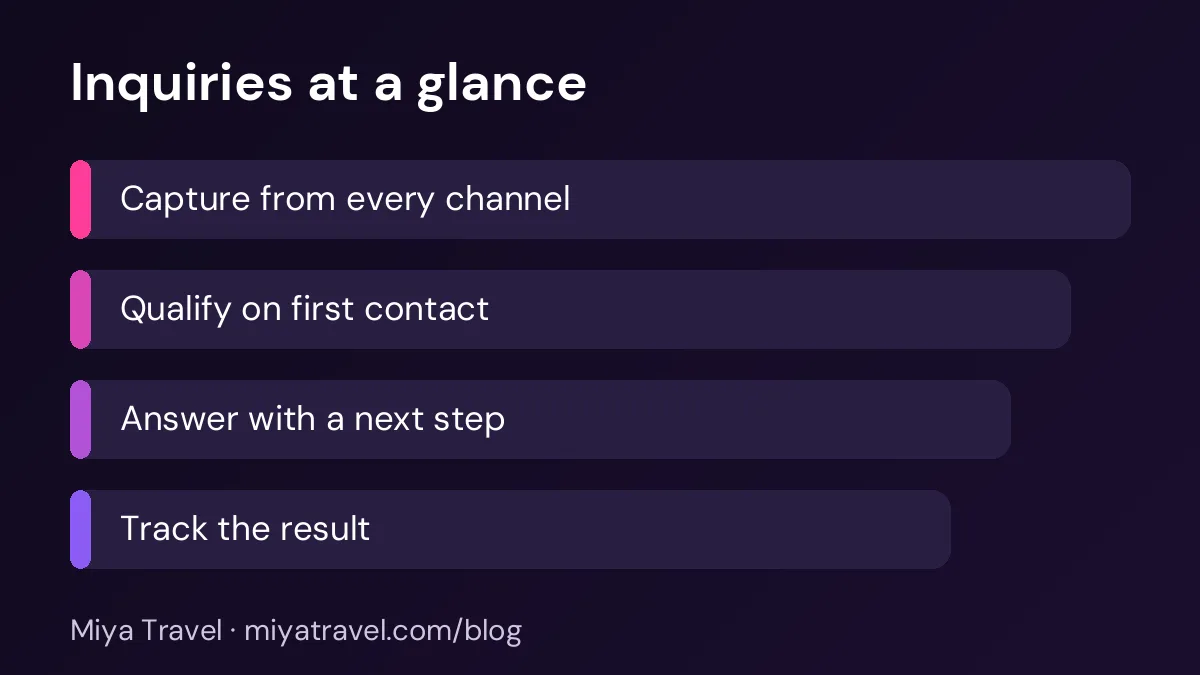
Inquiry management for a travel agency means capturing every enquiry from every channel, qualifying it quickly, answering with a clear next step and tracking the result. A consistent process turns more enquiries into quotations and bookings, and it stops good leads from slipping through.
An enquiry is the first sign that a client might buy. It may come as a phone call during lunch, a form on the website at night, a WhatsApp message while the agent is on the road, or a walk-in at the counter. Each one is valuable, and each one can be lost if the agency does not handle it properly. Travel agency inquiry management is the process of capturing, qualifying, answering and tracking every enquiry, so the agency turns more of them into quotations and bookings.
This guide gives you a practical process for inquiry management, the questions to ask on the first contact and the measures that show whether the process works.
Capture every enquiry from every channel
The first rule is that no enquiry should stay in a single person's phone or inbox. Every channel should feed one list. That includes phone calls, emails, website forms, WhatsApp, social media messages and walk-ins at the office.
Record the source with each enquiry. A website enquiry, a referral from a past client and a walk-in each tell you something different about your marketing. Over time, the source data shows which channels bring the best enquiries.
Do not wait for complete information before saving an enquiry. A name and a phone number are enough to start. You can complete the details during the first conversation.
Qualify quickly
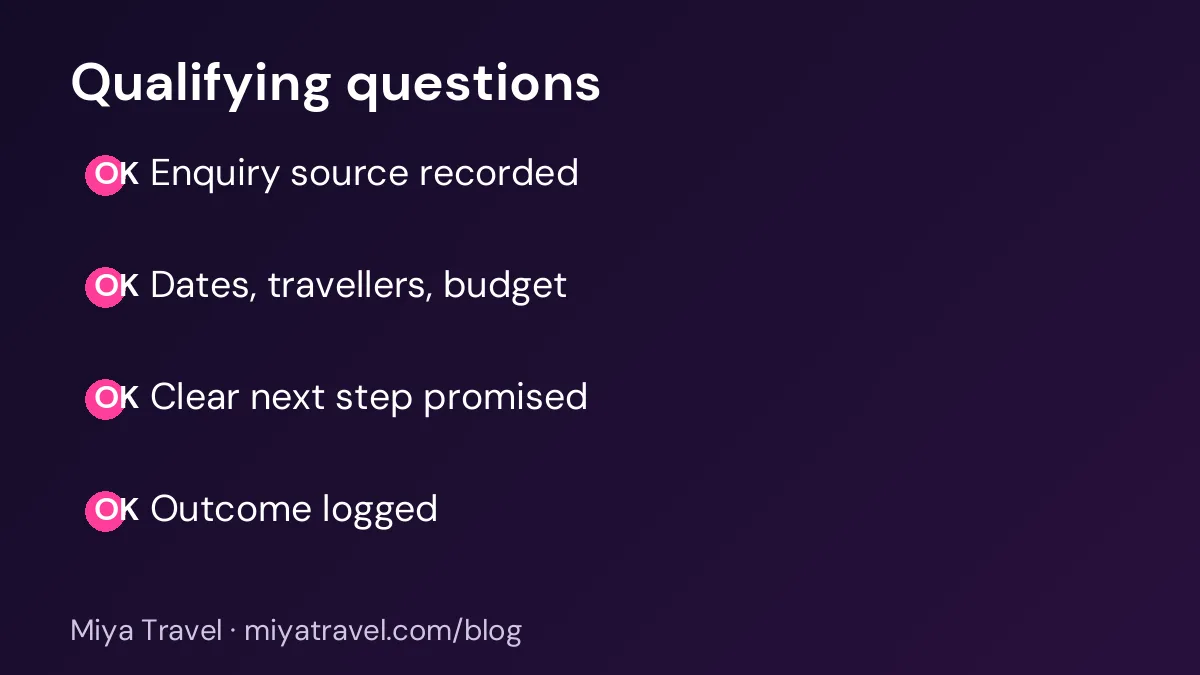
Qualifying means finding out whether the enquiry is real and what the client needs. The key details are the destination, the travel dates or month, the number of travellers, the budget range and the type of trip, such as a family holiday, a group or a honeymoon.
Ask these questions in a short, friendly conversation, not as a long form. If the client is on WhatsApp, ask two or three questions in one message. Clients answer more reliably when they can see all the questions together.
Once you have the key details, decide the next step. A clear enquiry can move to a quotation. An unclear one may need a call to clarify. An enquiry outside your services should be politely declined, so the team does not spend time on it.
Record the budget range, not only the exact figure. "Around ₹1 lakh per person" gives you room to suggest options, while a single number can close the conversation too early.
Answer with a clear next step
Every reply should end with a next step, for example: "I will send three options by 5 pm today," or "Can we speak tomorrow at 11 am to confirm the dates?" A reply without a next step leaves the client waiting, and the enquiry often goes cold.
Set a response time standard. A common target is to reply within an hour during working hours, and within the same day for enquiries received late. Track how often the team meets the standard, because slow replies are one of the biggest causes of lost bookings.
Track the result of each enquiry
Each enquiry should move through clear stages: new, contacted, qualified, quoted, won or lost. For a lost enquiry, record the reason, such as price, dates unavailable, the client chose another agency or no response. These reasons are useful. Over a quarter, they show you whether the problem is price, product, timing or follow-up.
Review the open enquiries each morning. Any enquiry without a next step or with a due date in the past needs attention first.
Handle peak periods
Enquiries come in waves. A festival season, a school holiday or a long weekend can bring more enquiries in two weeks than the team usually receives in a month. Plan for these peaks. Add temporary support, use quotation templates and agree which enquiries get priority.
A simple rule helps. Respond first to enquiries with dates in the next thirty days, because they are closest to a decision. Respond to enquiries for future dates next, and use a short acknowledgement with a promise to follow up.
Use templates carefully
Templates help when many enquiries ask similar questions, such as the inclusions for a package or the documents needed for a visa. Keep templates short, and add a personal detail before you send them. A reply that starts with the client's name and mentions their destination feels more helpful than a generic message.
Common mistakes
The first mistake is leaving enquiries in personal inboxes. The second is answering without asking the key questions. The third is no next step. The fourth is no owner, so two people reply and the client gets confused. The fifth is losing the reason when an enquiry is lost.
Another common mistake is treating every enquiry the same. A large group enquiry needs a proposal and a call. A simple question about a single hotel needs a quick, accurate answer. Match the effort to the value.
Measure the process
Track four measures each week: the number of new enquiries by source, the average time to first reply, the percentage of enquiries that reach a quotation, and the main reasons enquiries are lost. These measures show you where the process works and where it breaks.
If the reply time is slow, add cover during peak hours. If enquiries do not reach quotations, check the qualifying questions and the speed of the first quotation. If the lost reasons point to price, review your packages with the team.
A simple daily routine
Start the day by reviewing new enquiries from the previous evening. Reply to each one with a next step. During the day, log every call and message in the enquiry record. End the day by checking the open enquiries and setting the next follow-up for each. This routine takes about twenty minutes and keeps the process moving.
Choosing a tool for inquiry management
Look for a tool that captures enquiries from several channels, records the source, supports the qualifying questions and shows the next step for each enquiry. Ask the vendor to show ten enquiries from different sources in one list, and check how quickly an owner can find the ones due today.
Miya Travel tracks leads with statuses and owners, linking each lead to customers and quotations. Check the leads documentation to see how the enquiry list and the follow-up steps work together.
Handling enquiries from partners and intermediaries
Some enquiries come from other travel businesses, such as a small agency that does not offer a particular destination, or a corporate travel desk that outsources leisure bookings. These partner enquiries can be valuable, but they need a different process. Agree the commission, the pricing basis and the payment terms in writing before you quote.
Record the partner as a source and link every enquiry to the partner's record. This makes it easy to see which partners bring the best business and which ones need a conversation about quality. Respond to partner enquiries within the same standard as direct enquiries, because the partner's own client is waiting.
Protect the end client's experience. The client should receive a clear quotation and a clear point of contact, even when the enquiry came through a partner. Confirm with the partner who will speak to the client and who will handle changes. A clear division of responsibility avoids confusion and protects the relationship with both the partner and the client.
Keeping enquiry data secure
Enquiries contain personal details, such as names, phone numbers and travel plans. Treat this information with the same care as bookings. Limit who can see enquiries from each channel, delete old enquiries that you no longer need and do not share personal data with anyone outside the agency unless the client has agreed.
Check the enquiry forms on your website for the information they collect. Ask only for what you need to quote. A form that asks for passport numbers at the enquiry stage collects more data than necessary, and it puts the data at risk if the form is not secure.
Frequently asked questions
What is inquiry management in a travel agency?
It is the process of capturing every enquiry from every channel, qualifying it quickly, answering with a clear next step and tracking the outcome until it is won or lost.
Which questions should I ask in the first call?
Ask about the destination, the travel dates or month, the number of travellers, the budget range and the type of trip. Two or three questions at a time works well on WhatsApp.
How fast should I reply to an enquiry?
Aim for within an hour during working hours and the same day for late enquiries. Track how often the team meets this standard.
How do I handle a spike in enquiries?
Respond first to enquiries for dates within the next thirty days, use templates for common questions and agree which enquiries get priority.
Why should I record the reason an enquiry is lost?
The reasons show whether the problem is price, product, timing or follow-up, so you can fix the root cause rather than guessing.