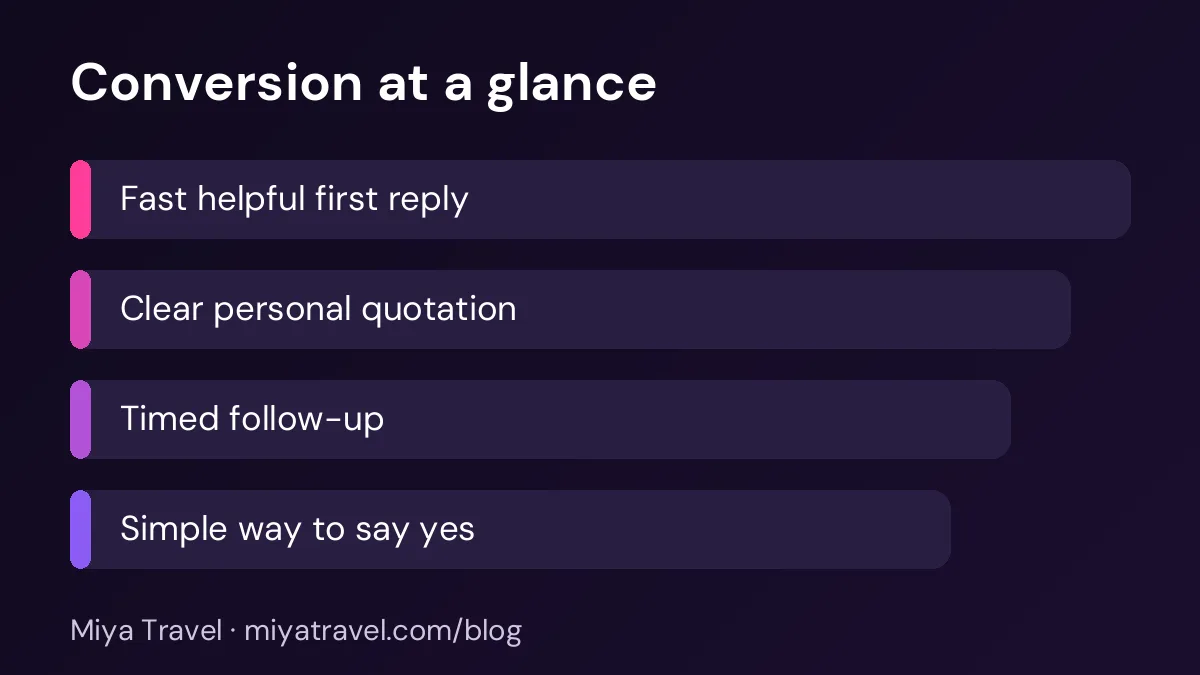
Converting travel inquiries into bookings depends on four things: a fast and helpful first reply, a clear and personal quotation, prompt and well-timed follow-up, and a simple way for the client to say yes. Agencies that improve these four steps usually see more bookings from the same number of enquiries.
Every travel agency receives enquiries. Far fewer turn into bookings, and the gap between the two is where most of the revenue is won or lost. The difference is rarely the price alone. It is usually the speed of the first reply, the clarity of the quotation, the timing of the follow-up and how easy the client finds it to say yes. This guide explains how to convert more of your existing enquiries into bookings, without spending more on marketing.
Measure the conversion funnel first
Before you change anything, measure where enquiries are lost. Count the enquiries received in a month, the ones that reached a first reply, the ones that reached a quotation and the ones that became bookings. The step with the biggest drop is where your effort should go first.
If many enquiries never get a reply, the problem is speed. If many get a reply but not a quotation, the problem is qualifying. If many get a quotation but not a booking, the problem is the offer, the price or the follow-up. Each problem has a different fix.
Step 1: Reply quickly and helpfully
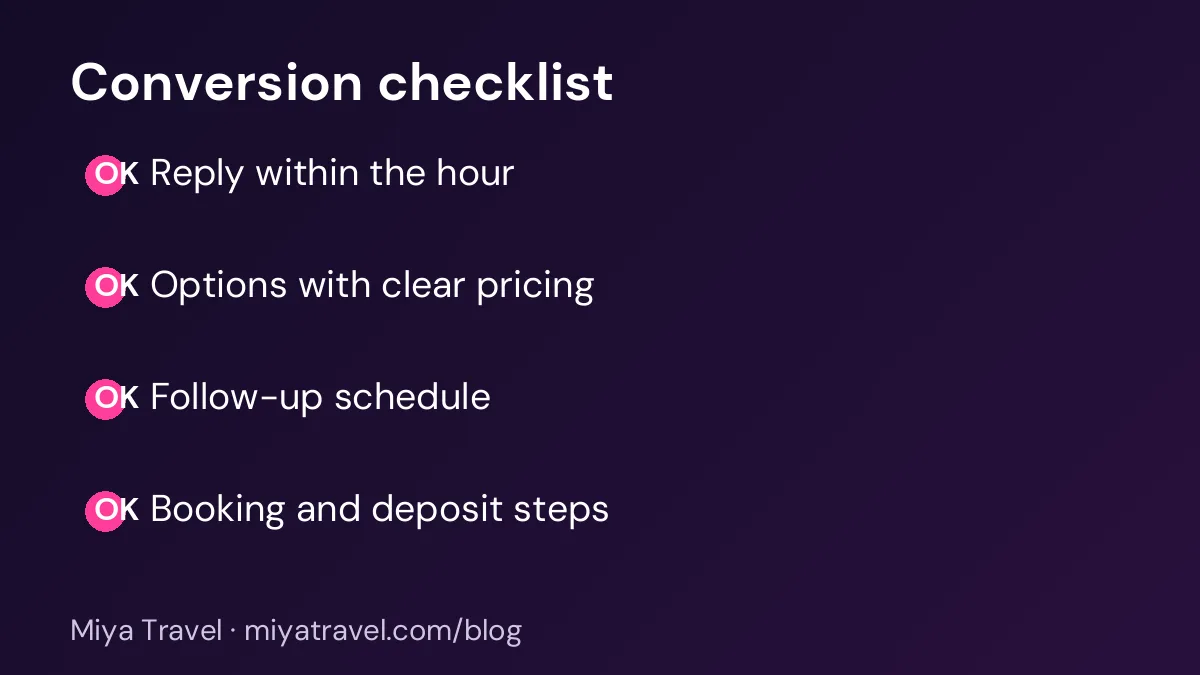
The first reply decides whether the client keeps talking to you. Aim to reply within an hour during working hours. The reply should acknowledge the enquiry, mention one detail from the client's message and ask the key questions. A reply that only says "Thank you, we will get back to you" wastes the client's interest.
Set a standard that the whole team follows. Track how often the standard is met each week. A team that replies in an hour converts more enquiries than one that replies the next day, because the client is still deciding when they hear back.
Step 2: Qualify before you quote
A quotation sent without the key details is often wrong, and wrong quotations lose clients. Before you quote, confirm the destination, the dates, the number of travellers, the budget range and the type of trip. If the client is unsure, offer two options at two budgets so they can point to the one they prefer.
Qualifying also protects your time. An enquiry that is clearly outside your services or budget should be politely declined so the team can focus on the good ones.
Ask one question that reveals the decision maker. "Will you be deciding alone, or with family or a company approver?" The answer changes how you should present the offer.
Step 3: Send a clear and personal quotation
A quotation should answer the client's questions before they ask. Show the day-wise plan, the hotels, the inclusions, the exclusions and the price per person. Keep the layout simple, and use the client's name and destination in the title. Two or three options are usually better than one, because the client can compare and choose.
Explain why each option suits the client. "This option keeps your children close to the pool and within a short drive of the main sights" is more persuasive than a list of features. A quotation that feels written for the client converts better than a generic brochure.
Step 4: Handle objections calmly
Clients object for predictable reasons: the price is too high, the dates are not right, the hotel is not what they expected or they are comparing with another agency. Listen to the objection and answer it directly. If the price is the issue, show a cheaper option or explain what is included. If the dates are the issue, offer alternatives. If they are comparing, ask what matters most to them.
Record the objections in the lead. Over a few months, the list of objections shows you where the offer needs to improve. A common objection can often be fixed in the quotation itself.
Step 5: Follow up with purpose
Most bookings are won after the second or third contact. Follow up the next working day after a quotation, then again after three days and once more after a week. Each follow-up should add something: a clearer option, a hotel photo, an answer to a question or a hold on rooms if the supplier allows it.
Avoid repeating the same message. A client who has seen the same "Just checking in" three times will stop replying. Give each follow-up a clear purpose.
Step 6: Make it easy to say yes
A booking should feel simple. Tell the client exactly what happens next: the deposit amount, how to pay, what documents are needed and when the vouchers will arrive. A client who knows the steps is more likely to proceed than one who is unsure what to do.
Offer the easiest payment method available to you, and confirm receipt the same day. A fast confirmation reassures the client and reduces the risk of a second thought.
Step 7: Ask for the booking directly
Many agents never ask for the booking. A simple question works well: "Shall I confirm the option with the sea-facing room for your dates?" Asking directly gives the client a clear choice and often produces a decision. Silence is rarely a yes, so ask.
Common mistakes
The first mistake is slow replies. The second is quotations without the key details. The third is too many options, which makes the decision harder. The fourth is a follow-up that adds nothing new. The fifth is never asking for the booking. The sixth is unclear payment steps, which lets the client delay.
Another mistake is ignoring lost enquiries. Record why each enquiry was lost, and review the reasons each month. The patterns show you what to fix.
Measure the results
Track four measures each week: the reply time, the percentage of enquiries that reach a quotation, the percentage of quotations that become bookings and the main reasons for lost enquiries. Review these numbers in your weekly meeting, and agree one improvement for the next week.
Over a few months, your conversion rate should improve as the team learns what works. Small gains compound, because each booking also brings referrals and repeat business.
Learning from the enquiries you lose
Lost enquiries are a rich source of learning. Each one tells you something about your offer, your price, your speed or your follow-up. Most agencies record the outcome but rarely study the pattern. Set aside time each month to review every lost enquiry from the period, and sort the reasons into groups.
Common groups include price too high, dates not available, chose a competitor, changed plans and no response. Count how many enquiries fall into each group. The largest group shows the biggest opportunity. If price is the main reason, check whether your offer explains its value clearly. If competitors are the main reason, check how quickly you responded compared with them.
Talk to a few clients who chose another agency, if they are willing. A short call asking what made their choice easy can reveal the things you are missing. Their honest answers are often more useful than any internal analysis, and they show you how to improve the next offer.
Building a repeatable sales conversation
Successful agents do not improvise every conversation. They follow a simple structure that they adapt to each client. The structure usually starts with a warm greeting and a question about the trip, moves to the key qualifying details, presents two or three options with a clear reason for each and ends with a suggested next step.
Write this structure down as a short guide for the team. Include the opening line, the five qualifying questions, the way to present an option, the common objections and the closing question. Ask each agent to adapt the guide in their own words, so it sounds natural to them and to the client.
Review recordings of calls if your tool or phone system allows it, or ask a colleague to listen in on a few calls each month. Give feedback focused on one improvement at a time. A small change, such as asking a clearer closing question, often lifts conversion more than a long training course.
Frequently asked questions
What is the most important step in converting enquiries?
Speed of the first reply. A fast, helpful reply keeps the client engaged while they decide, and it is the step that most agencies can improve immediately.
How many options should a quotation include?
Two or three. This gives the client a choice without making the decision harder.
How many follow-ups are reasonable before a booking?
Usually two or three, spaced over about a week, each with a clear purpose. After that, move the lead to a monthly check-in unless the client asks for more contact.
Should I offer a discount to close a booking?
Only within the authority your agency has set. Offering extras that cost you less, such as a room upgrade or a welcome gift, can be more effective than a price cut.
How do I know which step is losing bookings?
Measure the funnel: enquiries, first replies, quotations and bookings. The biggest drop shows where to focus.