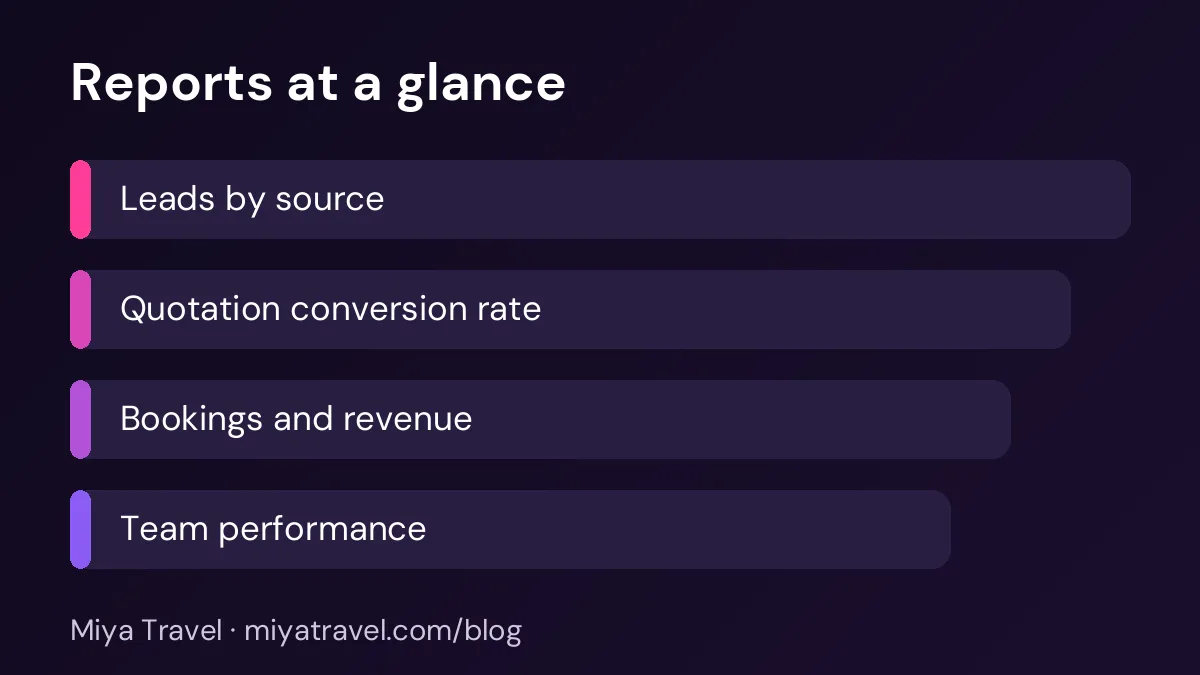
A travel agency needs a small set of sales reports that show leads by source, quotation conversion, bookings, revenue by package and team performance. Reviewing these numbers every week shows what to fix, while a long list of unused reports only creates noise.
A travel agency can generate a lot of numbers without learning much from them. A report with thirty charts looks impressive and rarely changes a decision. The reports that matter are short, regular and tied to actions. Travel agency sales reports should answer a few simple questions: where do leads come from, how many become quotations, how many become bookings, which packages earn the most and how is each team member performing.
This guide explains the reports every owner should review, how often to review them and how to act on what they show.
Start with the questions, not the charts
Before you build a report, write down the questions it must answer. Which channel brings the best enquiries? Where do leads get stuck? Which packages sell fastest? Who needs coaching this month? A report that does not answer a question is not worth the time.
Once the questions are clear, the report becomes obvious. Each question maps to one number or one small table. Keep the report to the questions that lead to decisions this month.
Leads by source
The first report counts new leads by source each week. Sources might include the website, referrals, WhatsApp, phone calls, walk-ins and social media. The count shows where your enquiries come from.
Compare the counts over time. A source that suddenly drops may mean a broken form or a paused advertisement. A source that grows steadily is worth more investment. Over a quarter, you will see which channels bring leads that actually become bookings, not only leads.
Quotation conversion
The second report shows how many leads reach a quotation, and how many quotations become bookings. This is the most important sales number for most agencies. If many leads reach a quotation but few book, the problem is usually the price, the itinerary or the speed of the quotation. If few leads reach a quotation, the problem is usually the first contact or the qualifying questions.
Track the conversion rate by package and by team member. The results often point to a specific fix, such as a better itinerary for one destination or extra coaching for one agent.
Review the quotation conversion rate every week, not only at the end of the month. A drop in quotations this week shows up as a drop in bookings two or three weeks later.
Bookings and revenue
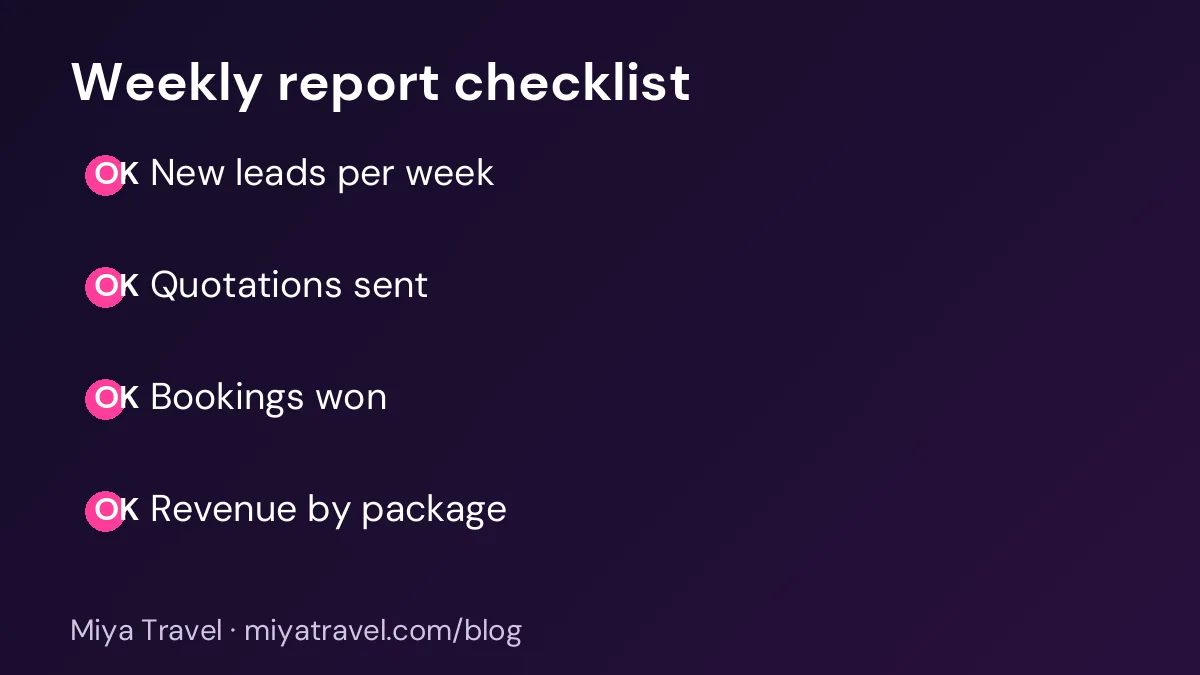
The third report lists bookings won in the period, with the value of each booking and the total revenue. Break it down by package or destination. A destination that brings high revenue but few bookings may be a premium product worth promoting. A destination with many small bookings may need a better package size.
Check the revenue against the bookings report, so that cancelled or changed trips are reflected correctly. A sales report that counts a cancelled booking as revenue will mislead the owner.
Revenue by package
Revenue by package shows which products carry the business. A package that sells often but earns little may need a price review, while a package that earns well but sells rarely may need better marketing. Compare the margin too, not only the revenue. A package with high sales and low margin can hide a problem.
Review the top five packages each month. Ask the team what customers say about them. The answers often explain the numbers.
Team performance
The team report should show each person's new leads, quotations sent, follow-ups completed and bookings won. Use these numbers for coaching, not for public ranking. A person with many quotations and few bookings may need help with the itinerary or the price explanation. A person with few leads may need more time in the enquiry stage.
Compare team members fairly. An agent who handles group enquiries may have fewer leads but higher value bookings. Look at the total picture before you judge.
A simple weekly routine
Set one time each week to review the reports, for example Monday morning. Look at the leads by source, the quotation conversion rate and the bookings won. Note the three most important changes from the previous week. Decide one action for each change, and assign an owner and a date.
The routine takes about thirty minutes. It is more valuable than a monthly report that arrives after the problem has grown.
A monthly review for the owner
Once a month, review the revenue by package, the margin by package and the team performance over the whole month. Look at the trends for the quarter, not only the last four weeks. Decide whether to change prices, add a package, drop a weak one or hire for a busy destination.
Record the decisions in writing. A decision that is not recorded is easy to forget, and the next month's report will show the same problem again.
Common mistakes
The first mistake is building too many reports. Start with five numbers and add more only when you need them. The second is mixing up leads and quotations, which makes the conversion rate look wrong. The third is counting revenue at the wrong time, for example when the enquiry arrives rather than when the booking is confirmed. The fourth is reviewing reports without acting on them.
Another mistake is using different definitions in different reports. Agree what counts as a lead, a quotation and a booking, and use the same definition in every report.
Choosing a reporting tool
Look for a tool that produces the five reports above from the same data as your leads, quotations and bookings. Ask the vendor to show the conversion report for one team member and one package. The numbers should match what you see in the records.
If the tool cannot produce these reports, a spreadsheet can work. Export the lead and booking data each week and build a pivot table. Keep the same definitions and the same report layout each time, so that trends are easy to see.
Miya Travel includes reports on the sales pipeline as part of the travel workflow. Check the documentation and confirm the report features in your plan before you plan around them.
Sharing reports with the team
Reports are most useful when the team sees them. Share the weekly summary with everyone, not only with the owner. Show the leads by source, the conversion rate and the bookings won, and keep the individual performance figures in a private view. Agents who understand the numbers can make better decisions about which leads to prioritise and which offers to make.
Explain what each number means. A conversion rate can be confusing if the team does not know how it is calculated. Write a one-line definition below each figure, such as "quotations sent divided by new leads in the same week". Clear definitions prevent arguments about whose number is right.
Celebrate progress as well as highlighting problems. A week in which the reply time improved or a new source brought a booking is worth sharing. Recognition based on real numbers motivates the team and shows that the reports are used to help, not only to judge.
Using reports to plan the season
Monthly and quarterly reports can guide planning for the coming season. Look at which packages sold well last season, which sources brought the most bookings and which months were busiest. Use this view to decide which destinations to promote, how many staff to roster in peak months and which suppliers to book early.
Compare this year with the same period last year. A growth figure can look good on its own but hide a slowdown in a key market. Comparing with the same period last year removes the effect of the season and shows the real trend.
Frequently asked questions
Which sales reports does a travel agency need?
Leads by source, quotation conversion, bookings and revenue, revenue by package, and team performance. Start with these five and add more only when you need them.
How often should I review sales reports?
Review the core numbers weekly and the broader trends monthly. Weekly reviews let you act before a problem grows.
What is a good quotation conversion rate?
It depends on your market, your packages and your season. Track your own rate over time and aim to improve it, rather than comparing with a fixed benchmark.
Should revenue be counted at enquiry or at booking?
Count revenue at confirmed booking, not at enquiry. Use the same rule in every report, and remove cancelled bookings from revenue.
Can I build these reports in Excel?
Yes. Export the lead and booking data weekly and use pivot tables. Keep the definitions and the layout the same each time.