
Employee management software for a travel agency assigns each staff member a role, shows the leads and quotations they own, tracks their targets and gives the owner a clear view of team performance. It helps small teams work fairly and spot problems early.
A travel agency is a people business. The owner may take the enquiry, the agent creates the quotation, the operations person confirms the hotel and the accounts person collects payments. When the team is small, everyone knows who does what. As the team grows to five, ten or fifteen people, roles blur. Two agents call the same client, a lead sits unowned for days and nobody knows who met the monthly target. Employee management software for a travel agency brings structure to this work without adding bureaucracy.
This guide explains how to set roles and targets, how to assign leads fairly and how to review performance in a way that helps the team improve.
Start with clear roles
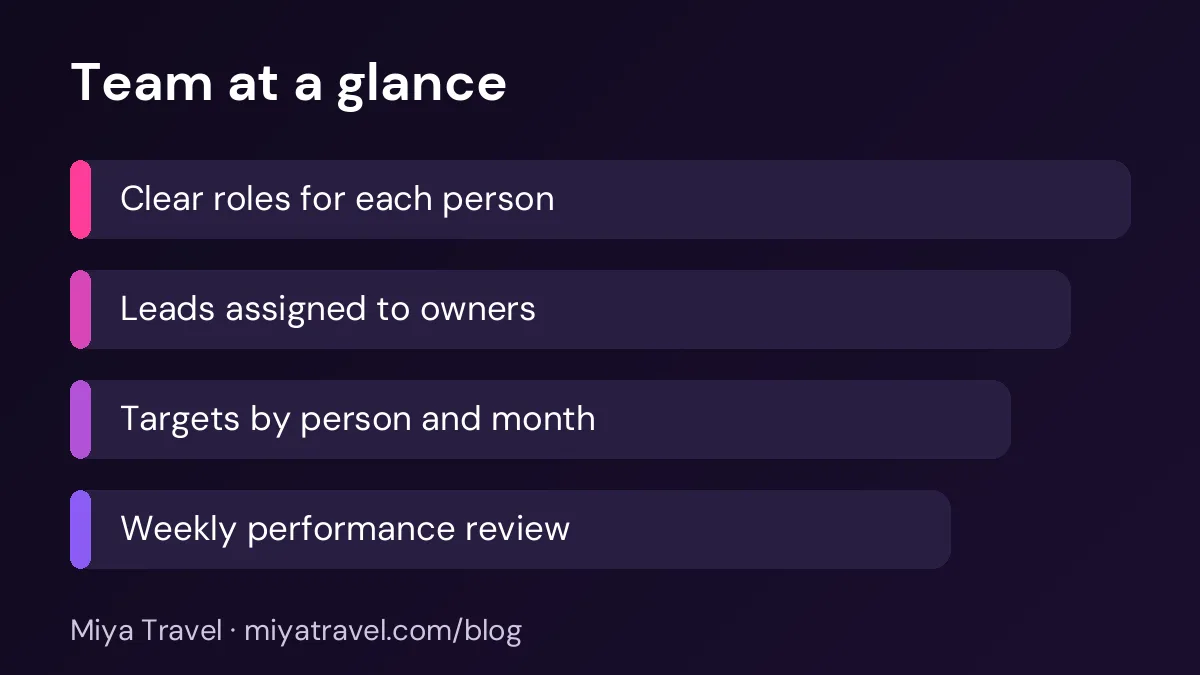
Every person in the agency should have a role that describes what they own. A common setup has an owner who sees everything, a sales agent who handles enquiries and quotations, an operations person who confirms suppliers and an accounts person who records payments. Smaller agencies combine roles, but the responsibilities should still be written down.
Write one line for each role describing the main job. For example, "Sales agent: owns new enquiries, sends quotations and follows up until the lead is won or lost." When everyone knows their line, the handover between roles is clearer.
Assign leads with a simple rule
Lead assignment is where most conflicts start. A rule that is clear and fair prevents arguments. Common rules include assigning by destination, by language, by region or in turn. Some agencies give senior agents the high-value enquiries and new agents the simpler ones.
Whatever rule you choose, write it down and apply it consistently. A lead should have one owner from the moment it arrives. If the owner is away, the lead should be reassigned by the team lead, not left unowned.
Review lead assignments every Monday. Check that no agent has far more open leads than others, and that the leads are moving through the stages.
Set targets that are fair
Targets should be based on the work each person can control. For a sales agent, useful targets include the number of quotations sent, the number of follow-ups completed and the number of bookings won. Revenue targets matter too, but they depend on destinations and seasons, so use them with care.
Set monthly targets and review them weekly. A weekly review lets you adjust the plan when a festival season or a supplier problem changes the picture. A target that is never reviewed becomes a source of frustration.
Track activity, not only results
Results such as bookings are important, but they lag behind effort. A sales agent may send twenty quotations in a week and see the bookings only three weeks later. Track activity too: the number of calls, messages, quotations and follow-ups completed each day.
Activity numbers help you coach. If an agent sends many quotations but wins few bookings, the problem may be the quality of their itinerary or their follow-up timing. If an agent wins bookings but has few new leads, they may need more time in the enquiry stage.
Run a short weekly review
A weekly review should last thirty minutes. Look at each person's open leads, quotations sent and bookings won. Ask what slowed them down and what helped. Agree one improvement for the coming week. Keep the tone supportive. People work harder when they see that the review helps them, not only that it checks them.
Record the agreed actions in writing and check them the following week. This short cycle builds a team that learns from its own results.
Handle leaves and handovers
Staff leave, get sick or move on. Employee management software should make handovers simple. The leads owned by a departing person should move to a named colleague, with the next action and the date. Do not leave them in the old owner's name, because they will be forgotten.
Keep a handover note in each lead for anything unusual, such as a client who prefers a specific guide or a payment arrangement. These notes protect the client's experience when a new person takes over.
Common mistakes
The first mistake is no clear owner for each lead. The second is targets that reward volume over quality. The third is reviewing performance only at the end of the year. The fourth is ignoring the team's own ideas for improvement. Often, the agent closest to the client knows the best fix.
Another mistake is tying every target to revenue alone. A new agent who is learning the destinations may need a few months before revenue appears. Use activity and quality measures for the first quarter, then add revenue.
Choosing employee management features
Look for a tool that gives each person a role with the right access, assigns leads to owners, shows the status of each lead and produces simple performance reports by person. Ask the vendor to show the owner view and the agent view side by side, so you can see what each person sees.
Check how permissions work. An agent should see their own leads and, if you choose, the team's leads for reference. Pricing and payment details may need tighter access. Confirm these rules during the demo.
Miya Travel includes team workspaces and role-based access, with leads, customers and quotations linked to each owner. Check the roles and permissions documentation and the invite and manage agents guide for the current features.
A simple setup for the first month
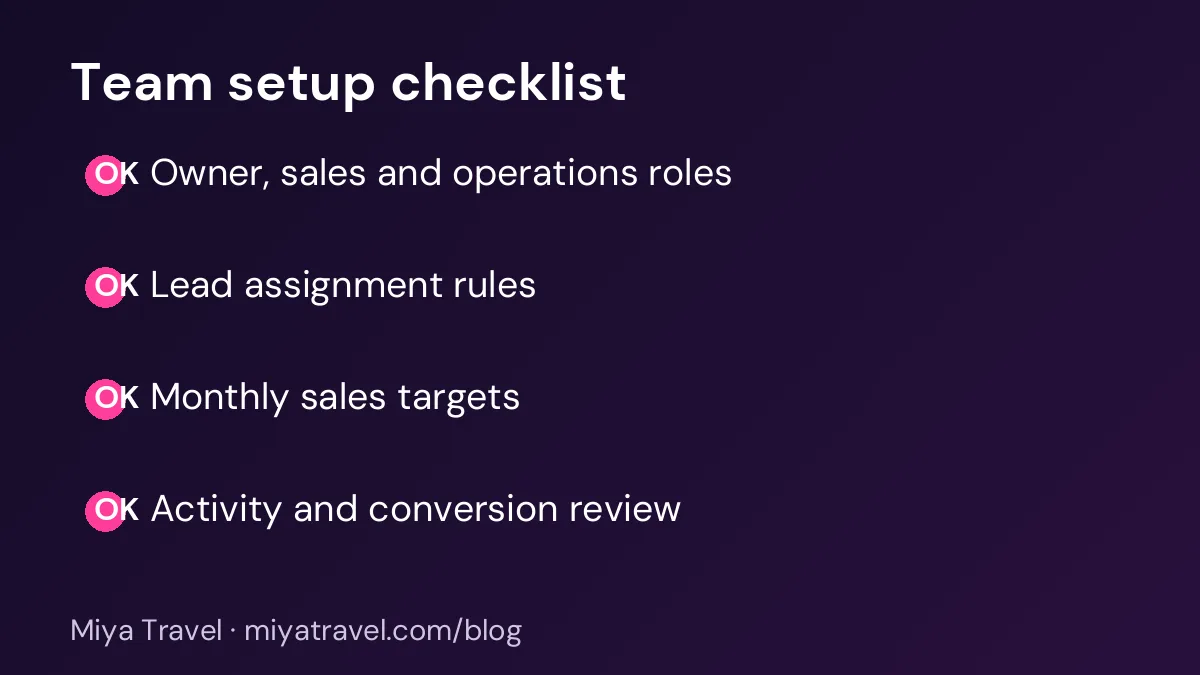
In week one, define roles and write one line for each. In week two, set the lead assignment rule and move open leads to owners. In week three, set monthly targets with each person and agree the activity measures. In week four, hold the first weekly review and record the actions. From then on, repeat the review every week and adjust one thing at a time.
Supporting staff wellbeing and workload
Performance and wellbeing go together. A team member who is overloaded with leads, follow-ups and urgent changes will eventually make mistakes or leave. Watch the workload as carefully as the sales numbers. Count the open leads and overdue follow-ups for each person, and talk to anyone whose numbers are consistently far above the rest of the team.
Share the workload fairly. If one agent handles most of the international enquiries, the lead assignment rule may need to change. If one person covers every weekend, consider a rota that spreads the load. A fair workload is one of the strongest signs that the owner values the team.
Recognise effort, not only results. A person who handles a difficult client calmly or who takes on a complex group booking deserves thanks, even if the booking has not closed yet. Recognition that is specific and timely keeps people engaged through the busy season and the quiet months alike.
Make time for regular one-to-one conversations. A short monthly chat, away from the numbers, lets staff raise concerns about the work, the tools or the team. Many problems that appear as performance issues are really workload or process issues, and a conversation reveals them early.
Frequently asked questions
What is employee management software for a travel agency?
It is software or a process that helps a travel agency set staff roles, assign leads to owners, track targets and activity, and review performance regularly.
How should leads be assigned in a travel agency?
Use a clear rule such as destination, language, region or rotation. Give each lead one owner from the start, and reassign it quickly if the owner is away.
Should targets be based on revenue?
Use a mix. Revenue matters, but it lags behind effort and depends on the season. Include activity and quality measures, such as quotations sent and follow-ups completed.
How often should I review team performance?
Review the numbers weekly and hold a short coaching review each week. Use a longer monthly review to adjust targets.
What happens to leads when a staff member leaves?
Reassign them to a named colleague with the next action and date. Add a handover note for anything unusual about the client.