
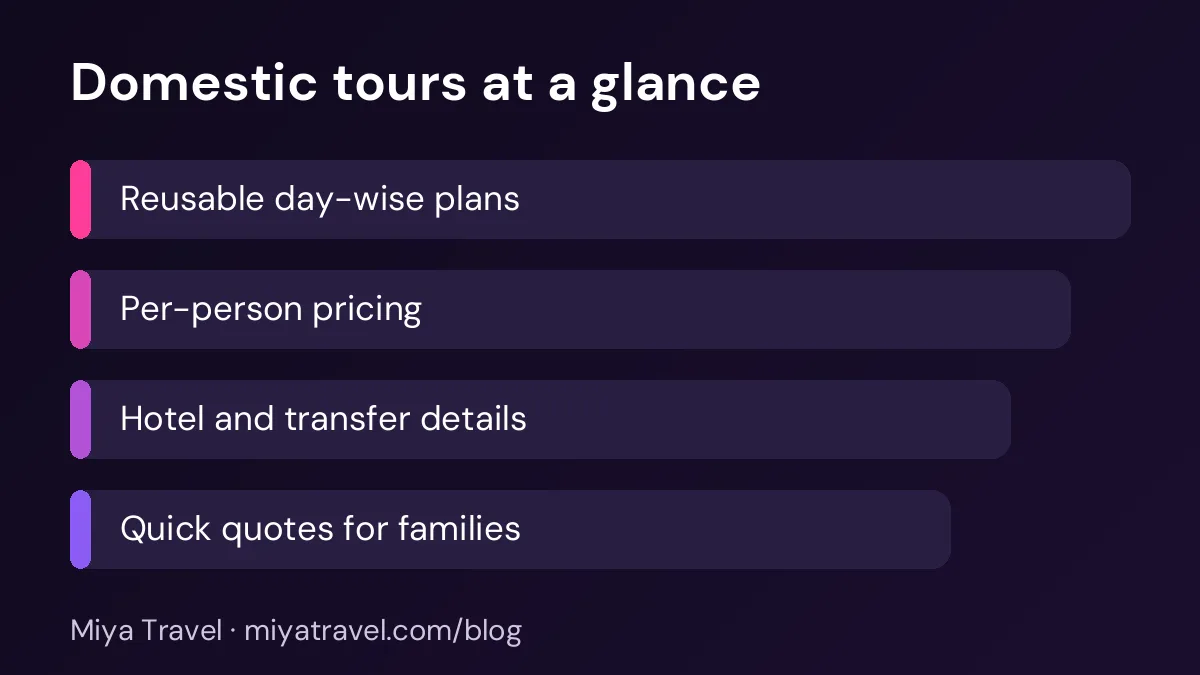
Domestic tour package software helps Indian travel agencies build reusable packages for popular circuits, price per person clearly, reuse day-wise plans and quote family and group tours quickly. The goal is to turn each domestic enquiry into a clear, accurate quotation in less time.
Domestic tours are the bread and butter of many Indian travel agencies. A family wants a four-day pilgrimage, a group of colleagues wants a weekend hill station trip, and a retired couple wants a relaxed tour of the golden triangle. These enquiries are frequent, the packages follow familiar circuits and the price sensitivity is high. Domestic tour package software helps agencies build reusable packages, price them per person and quote them quickly, so the team spends time on the client rather than on rebuilding the same itinerary.
This guide explains how to structure domestic packages, what the software should support and how to keep prices and plans current.
Build packages around popular circuits
Most domestic enquiries fit a set of popular circuits. Examples include the golden triangle of Delhi, Agra and Jaipur, the Kerala backwaters, the hill stations of north India and the pilgrimage routes that many families travel. Start by identifying the five or six circuits your agency sells most often.
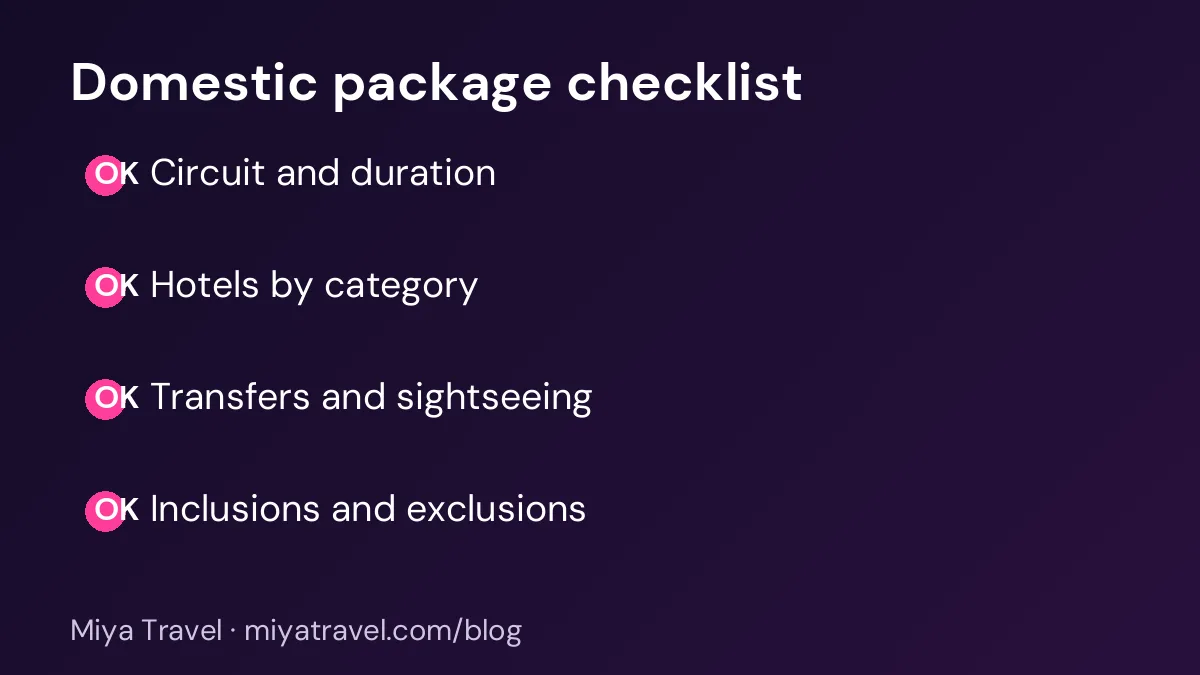
For each circuit, create a base package with a standard number of days, the usual cities, a typical hotel category and the common sightseeing. This base becomes the template. Each client quotation starts from the base and changes only the dates, the hotels, the number of travellers and the extras.
Structure the day-wise plan
A domestic plan should be easy to follow. Each day should name the city, the main sights, the travel time between cities and the hotel for the night. Keep the day to a realistic amount of travel. For Indian roads and trains, a long transfer can take most of a day, so check the timing before you promise a full schedule.
Add meal notes where they matter, such as breakfast included or dinner on own. Clear notes prevent confusion on the trip, especially for families who plan meals around specific timings or dietary needs.
Test each standard plan yourself or ask a trusted driver or guide to review the timings. A plan that looks good on paper may be too tight for the actual roads.
Price per person clearly
Domestic clients compare prices quickly, so the quotation should show the price per person clearly, with the number of travellers and the sharing basis. Show the price for a double or triple sharing, and the supplement for a single room. Children's pricing should be explicit, with the age limit and whether a child needs a bed.
Break the price into accommodation, transport, sightseeing and the service fee. This breakdown helps the client see where the money goes. Keep the taxes and charges visible as separate lines.
Manage seasonal rates
Domestic destinations have strong seasons. Hill stations rise in summer and festival periods, and popular temples have peak days. Keep rates by season in the package or the rate sheet, so the quotation uses the right figure. A package quoted at the off-season rate in peak season can lose money.
Review seasonal rates each quarter, and update the package as soon as a hotel changes its rate. Stale rates are one of the most common causes of margin loss in domestic tours.
Reuse components across packages
Many components repeat across packages. The same hotel may appear in three circuits, and the same transfer may serve two routes. Store each component once, with its rate and contact details, and link it to the packages that use it. When a hotel changes its rate, the change flows to every package that uses it.
This reuse saves time and reduces errors. It also makes it easier to compare packages, because the same supplier details appear in each one.
Quote families and groups
Families need clear information about child pricing, room arrangements and the pace of the trip. Groups need a passenger list, a rooming plan and a payment schedule. Use the same base package, then add the family or group details at the quotation stage.
For a group, show the price per person at different group sizes if the rate changes with the headcount. This helps the group leader plan the budget and decide quickly.
Common mistakes
The first mistake is an outdated package with old prices or hotels that no longer operate. The second is a plan that ignores travel time. The third is unclear child pricing. The fourth is a missing single supplement, which surprises solo travellers. The fifth is no record of the package version sent to the client.
Another mistake is building a package that is too rigid. Clients often want a small change, such as an extra half-day in one city. The package should allow quick changes without rebuilding the whole plan.
What to check in a tool
Look for a tool that stores packages as reusable templates, links hotels and transfers to packages, supports per-person pricing with sharing rules and keeps seasonal rates. Ask the vendor to build a package from a template, change the dates and show the new price. The change should take minutes, not an hour.
Check whether you can save each quotation version and send a PDF that matches the package. A client who receives a clear, branded PDF with the day plan and inclusions is more likely to book.
Miya Travel supports quotations and itineraries for travel agencies in India. Check the travel quotation software page and the quotations documentation for the current features.
A monthly package review
Review each domestic package once a month. Check the hotel rates, the transfer costs, the sightseeing entry fees and the inclusions. Look at the margin for each package. Remove packages that sell rarely or earn little, and add new circuits when enquiries show clear demand.
This routine keeps your packages current, competitive and profitable.
Designing packages for different travellers
Domestic clients are not all the same. A young couple wants flexibility and good photo stops. A family with elderly parents wants fewer transfers and rooms on the ground floor. A group of colleagues wants a social schedule and a simple payment plan. One package can serve more than one of these travellers if the design allows it.
Build a core itinerary with optional add-ons. The core shows the cities, the nights and the main sights. Add-ons might include a sunrise visit, a cooking class, a private boat ride or an extra night in one city. Price each add-on separately, so the client can choose what they want and the agency can see which add-ons sell.
Consider the pace of the trip for each type of traveller. A relaxed package for seniors should have fewer hours on the road each day and more time at each stop. An active package for younger travellers can include early starts and longer walks. Use the same base package, but adjust the pace and the add-ons for each client.
Record the traveller profile in the enquiry, so the right version of the package is offered. A quotation that suits the family's real needs converts better than a generic package with the same price.
Managing peak-season capacity
Domestic destinations can be fully booked during festivals, school holidays and long weekends. A package that works in quiet months may fail in peak season if hotels are full or transport is limited. Plan capacity early, by confirming room blocks and vehicle slots for the peak dates.
Keep a short list of backup hotels for each circuit. When the main hotel is full, the backup should meet the same standard and fit the same day plan. Record the backup in the package, so the team can offer it quickly without rebuilding the itinerary.
Tell clients clearly when a date is in peak season. Explain the higher rate, the limited availability and the booking deadline. A clear message helps the client decide early, and it avoids disappointment when a price changes.
Frequently asked questions
What is domestic tour package software?
It is software that helps travel agencies build reusable packages for domestic circuits, with day-wise plans, hotels, transfers, per-person pricing and quotation tools.
How do I price a domestic package per person?
Add the cost of accommodation, transport, sightseeing and meals for the number of nights and travellers, then add your service fee. Show the price for each sharing type and any single supplement.
How often should I update domestic package rates?
Review rates each quarter and update them as soon as a hotel or transport supplier changes its price. Seasonal rates should be applied before each peak period.
Should I show child prices on the quotation?
Yes. Show the age limit, whether the child needs a bed, and the price for each child category, so the family can budget clearly.
How can I reuse a package for another client?
Copy the base package, change the dates, hotels and travellers, update the prices and check the day plan before you send it.