A visa document checklist for travel agents lists the passport, photos, application forms, bank statements, travel and hotel proof and any invitation or insurance documents, with checks for validity, clarity and name matching. A complete, correct file prevents most visa rejections and delays.
Most visa rejections are not caused by a difficult application. They are caused by a missing document, a blurred scan, a name that does not match the passport or a form signed in the wrong place. A travel agent who uses a clear visa document checklist avoids most of these problems. The checklist turns a complicated list of requirements into a short set of items to collect, check and file before every submission.
This guide gives you a practical checklist for travel agents, explains the checks that matter most and shows how to use the list with clients who send documents late.
Always start from the official requirements
A checklist is only as good as the source it comes from. Before you use any list, check the official embassy or consulate website for the destination and the visa type. Requirements change, and a list copied from an old forum post may be out of date. Save the official requirement with the date you checked it.
Treat your checklist as a template that you update for each country. A tourist visa, a business visa and a family visit visa may need different documents. Keep a separate checklist for each visa type.
The core documents
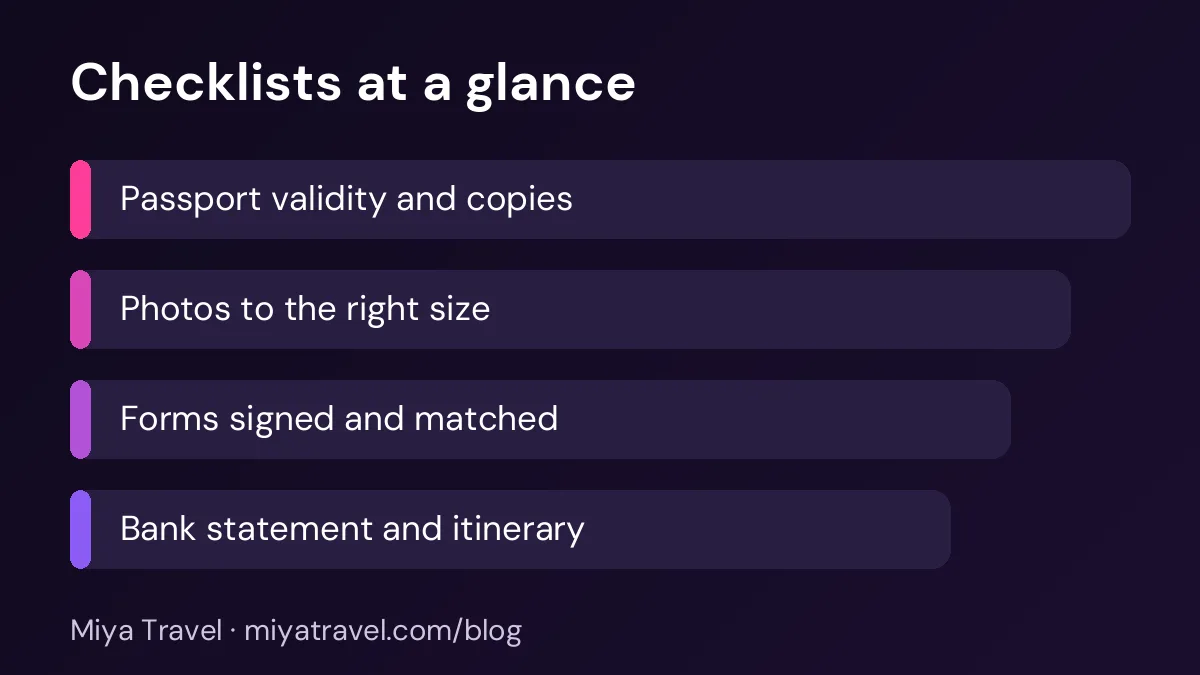
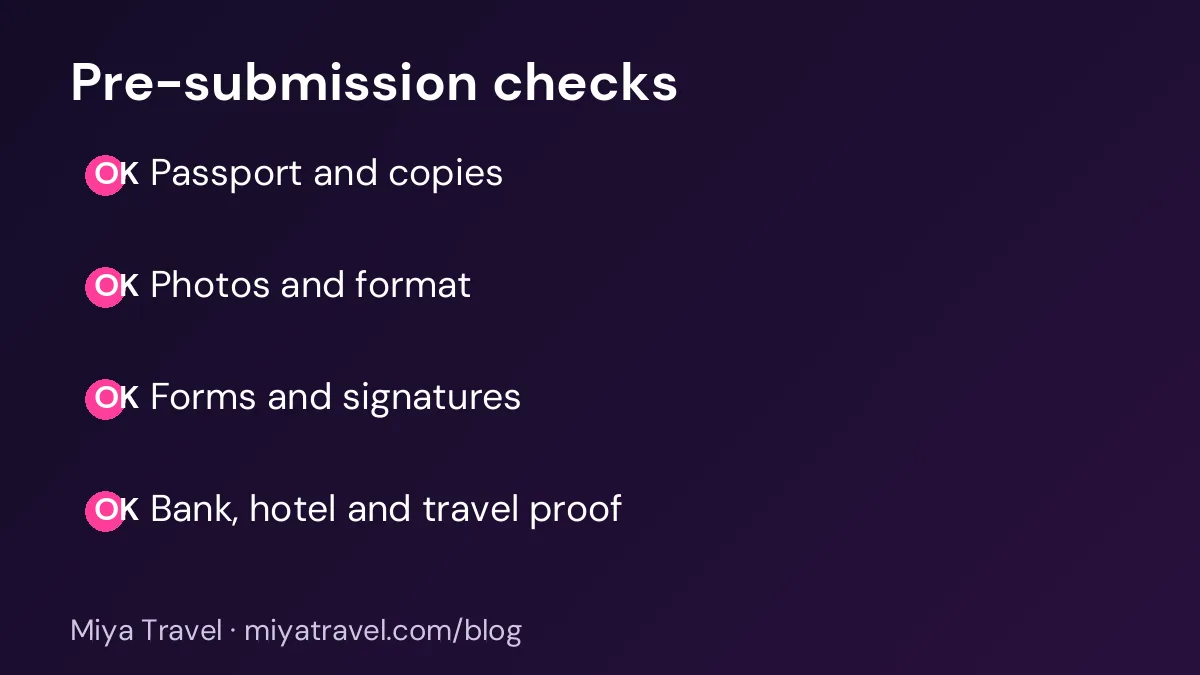
The passport is the first item. Check that it is valid for the period the destination requires, usually with some months of validity beyond the travel date. Make a clear copy of the photo page and any page with previous visas or stamps that the embassy may ask for.
Photographs come next. The size, background and recency rules are strict in many countries. Check the requirements exactly, and ask the client to bring the photos in the required format before the appointment.
The application form must be complete and signed. Check that the details on the form match the passport exactly, including the spelling, the date of birth and the passport number. A small difference can cause a rejection or a delay.
Financial and travel documents
Most visa applications ask for proof of funds. A recent bank statement is the usual document, often covering the last three to six months. Check that the statement is clear, that the balance is sufficient for the trip and that the account holder's name matches the passport.
Travel proof includes a confirmed flight itinerary or a tentative plan, depending on the requirement. Hotel proof includes a booking or a letter from the host. Keep both documents current, because dates on a draft itinerary can change and cause confusion.
Check the bank statement against the travel budget before you submit. If the balance looks low for the trip, ask the client for an additional document, such as a fixed deposit certificate, before the appointment.
Extra documents by destination
Some destinations ask for more. These may include an invitation letter from a host, a letter from the employer, a travel insurance certificate, a no-objection letter for a minor travelling with one parent, or proof of family relationship. Add these to the checklist for the relevant country, and ask the client early so they have time to collect them.
For minors, the rules about consent and accompanying adults can be strict. Confirm the requirements with the embassy before the client travels.
Checks that prevent rejection
Before you submit, check every document in one short review. Confirm that the names match across the passport, form, bank statement and booking. Check that the dates are consistent, such as the travel dates on the itinerary and the form. Confirm that scans are clear, with all corners visible and no shadows.
Ask a second person to check the file for the first few applications. A fresh pair of eyes catches mistakes that the agent has stopped seeing.
Working with clients who send documents late
Clients often send documents in pieces, late or in the wrong format. Send the checklist on the day the booking is confirmed, with a sample of each document. Set a deadline for each item and explain what happens if it is missed. A calm, specific message works better than repeated general reminders.
Keep a record of each document received, with the date and a check mark once verified. When the embassy asks for something extra, you can show exactly what was submitted and when.
Storing the checklist with the file
Store the completed checklist with the visa file, not in a separate folder. This makes it easy to see what is missing and to answer a question from the embassy. Keep copies of everything you submit, and note the appointment date, the submission date and the expected decision date.
After the passport is returned, mark the file as complete, and record any feedback for the next application to that country.
Common mistakes
The first mistake is using an old checklist without checking the official site. The second is accepting a blurred scan. The third is a name that does not match the passport. The fourth is missing a signature. The fifth is an outdated bank statement that does not show the most recent balance.
Another mistake is treating every visa as the same. A checklist that works for one country may be wrong for another, so keep the lists separate.
Using software for visa checklists
A visa tracker can hold a checklist for each visa type, track each document's status and send reminders. If you use software, check that it can attach the documents to the client record and show what is still missing. If you use a spreadsheet, use one row per client and one column per document, with a status drop-down.
Miya Travel includes checklists and tasks for travel teams. Check the checklists documentation for the current features, and read our visa tracking guide to see how the process fits together.
Documents for the three most common visa types
Most agencies sell a few visa types again and again. Build a separate checklist for each one, so the team does not have to search for requirements each time. A tourist visa usually asks for the passport, photographs, the form, the bank statement, the itinerary and the hotel proof. A business visa adds a letter from the employer and a company invitation. A family visit visa adds an invitation from the host and proof of their status in the country.
For each checklist, write the exact wording the embassy uses, and note the date you last checked it. Official terms change, so an old checklist can lead to a wrong file. Keep the source link with each checklist, so the person updating it can find the official page quickly.
Include a note on the number of copies required, the size of the photographs and whether originals must be shown at the appointment. These small details cause many avoidable delays, and they are easy to add to the checklist once and forget.
Review the three checklists once a quarter, or whenever a client reports a new requirement. A client who was asked for a document that was not on your list is a signal to update the checklist, not only to help that client.
Handling unusual cases
Some clients have circumstances that do not fit the standard checklist. A traveller with a previous visa refusal, a dual national, a person with a medical condition or a minor travelling without both parents may need extra documents or a different approach. Tell the client early that their case needs more review, and ask the embassy or consulate for the exact requirements.
Keep a short note in the file explaining the unusual circumstance and the documents provided. If the application is refused, this note helps you explain the situation to the client and to the next agent who handles the file.
Do not promise an outcome you cannot control. Explain that the embassy makes the final decision, and that the agency's role is to prepare a complete and accurate file. Clear expectations protect both the client and the agency.
Frequently asked questions
What documents are needed for most visa applications?
A valid passport, photographs in the required format, a completed and signed form, a recent bank statement, travel and hotel proof, and any country-specific documents.
How do I check that a checklist is current?
Check the official embassy or consulate website for the destination and visa type, and note the date you checked. Update the checklist when requirements change.
What causes most visa rejections?
Missing documents, unclear scans, name mismatches, unsigned forms and insufficient or outdated bank statements.
Should I keep one checklist for all countries?
No. Keep a separate checklist for each country and visa type, because requirements differ.
How early should I send the checklist to a client?
Send it on the day the booking is confirmed, with examples of each document and a deadline for each item.