
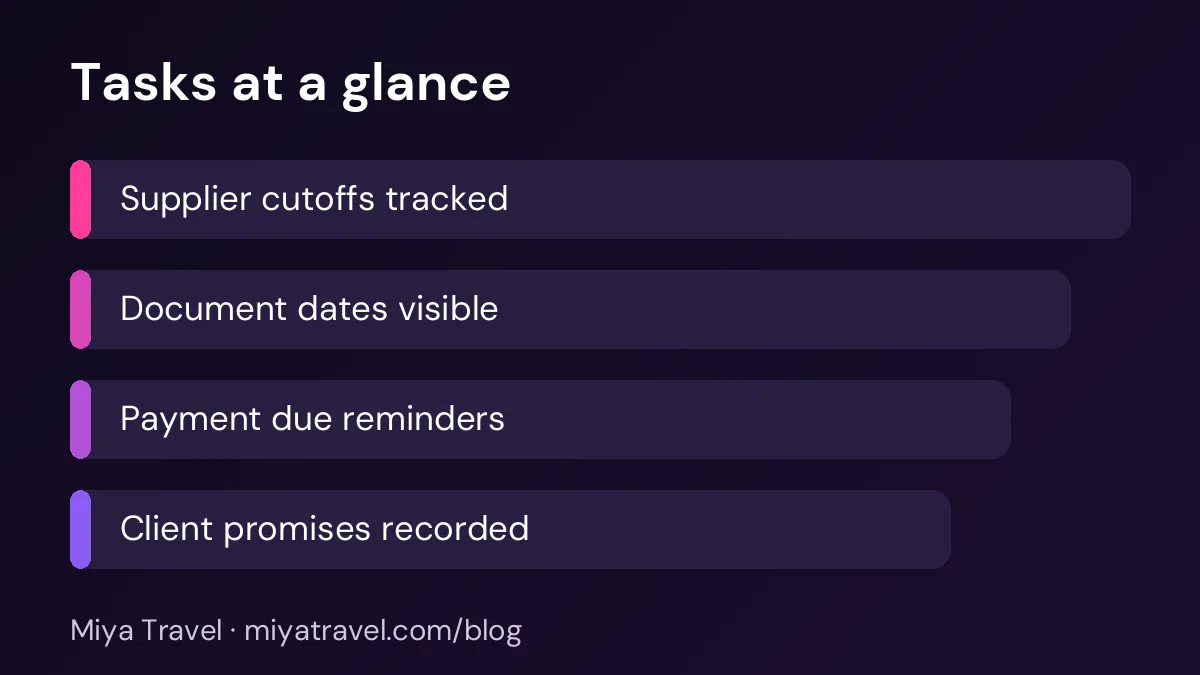
Task reminders for a travel agency keep every deadline visible to the person who owns it, including supplier cutoffs, document dates, payment due dates and promises made to clients. They turn the team's to-do list into a clear daily plan and prevent costly misses.
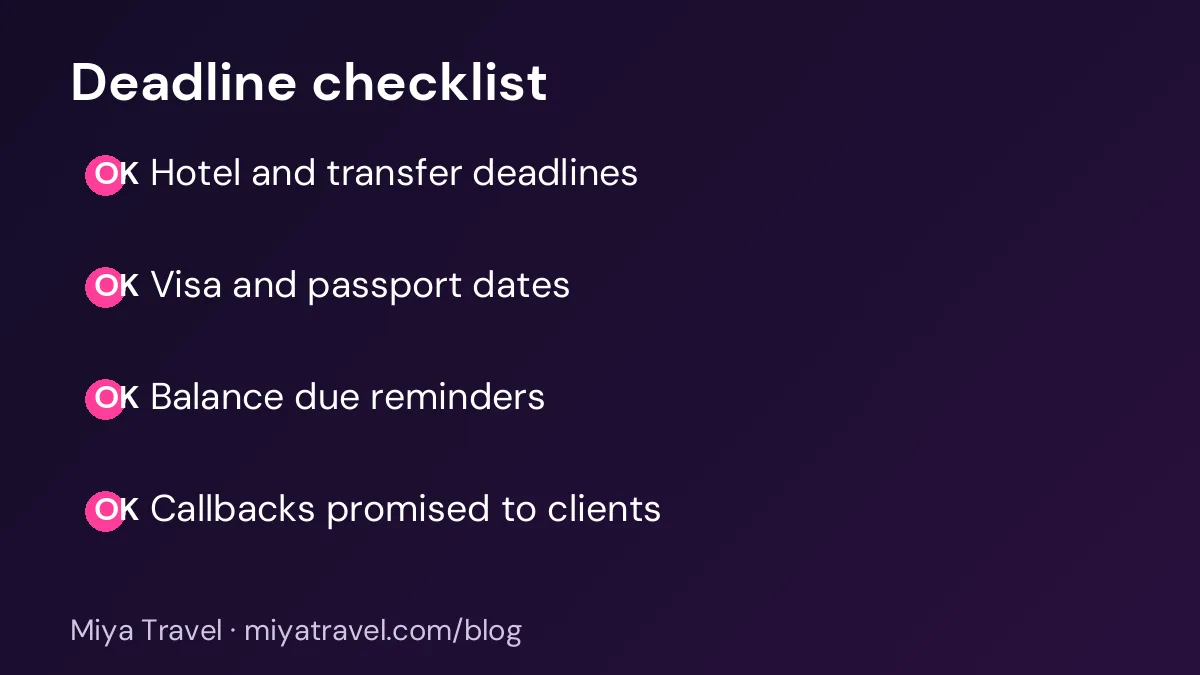
Travel is full of deadlines that nobody sees until they are missed. A hotel needs the final room list seven days before arrival. A visa appointment must be booked before the document deadline. A client was promised a call back on Thursday. A transfer operator needs the pickup list two days ahead. Each deadline is small on its own, but a missed one can cost money, upset a client or spoil a trip. Task reminders for a travel agency make these deadlines visible to the person responsible, long before they become a problem.
This guide explains which deadlines to track, how to set reminders that people will actually use and how to review them so that nothing slips through.
Which deadlines matter most
Start with supplier deadlines. Hotels, transport operators, guides and activity providers all have cutoffs for changes, confirmations and final numbers. Record each cutoff with the supplier name and the booking, so the reminder points to the exact trip.
Next, track document deadlines. Passport validity, visa appointment dates, submission dates and the date the passport must be returned all need reminders. Many visa problems are simply missed dates.
Then track payment dates. Advances, instalments and final balances each have a due date. A reminder for the balance a week before the due date gives the team time to follow up.
Finally, track promises made to clients. A callback, a revised quotation or a document check can all be promised in a single phone call. If the promise is not recorded, it is often forgotten.
Ask the team to write any promise to a client as a task before the call ends. A promise that is not in the system will be missed by someone, sooner or later.
Assign each task to one owner
Every task should have one owner. A task assigned to "the team" is a task nobody completes. The owner should be the person who will act on the deadline, not the person who created the task.
For supplier tasks, the operations person usually owns the deadline. For client promises, the agent who made the promise owns it. For payments, the accounts person or the booking owner owns it. Write the owner's name on every task.
Set reminders at the right time
A reminder that comes too late is useless. For supplier deadlines, set the first reminder about a week before the cutoff, then another two days before. For client callbacks, set the reminder at the time the client asked for, or a few minutes before. For visas, set reminders at the start of the window and again before the deadline.
Keep the number of reminders small. Three well-timed reminders are more effective than a stream of alerts that people learn to ignore. If a task is important enough to need five reminders, it may be important enough for the owner to act on it immediately.
Build a daily task view
Each morning, the owner of each area should see the tasks due today and the tasks overdue from yesterday. This list should be short enough to finish in a few hours. If the list is too long, the team is either taking on too much or the tasks are not being prioritised.
Mark tasks as done as soon as they are complete, and add a note if the outcome matters. A task that says "Hotel confirmed, reference ABC123" is far more useful than a tick mark alone.
Review overdue tasks every day
Overdue tasks are the most important tasks. Review them every morning, starting with the ones that have a client impact. A missed supplier deadline may cost money, a missed client callback may lose the client, and a missed document date may delay a trip. Give overdue tasks priority over new work.
If a task is overdue for two days, the owner should explain why and set a new date. If it has been overdue for longer, ask whether it is still needed. Some tasks become irrelevant when plans change, and removing them keeps the list honest.
Use checklists for repeated work
Many deadlines follow a pattern. Every trip to a certain destination needs the same five tasks in the same order. Create a checklist for each common trip type, such as a domestic family holiday, an international package or a group tour. When a booking is confirmed, the checklist adds the tasks with the right dates.
A checklist also helps new staff. They can see the full set of deadlines without asking a senior colleague.
Common mistakes
The first mistake is tasks without dates. A task that says "check hotel" is not a task until it has a due date and an owner. The second is too many reminders, which people learn to ignore. The third is no review, so overdue tasks build up unnoticed. The fourth is tasks that are never closed, which makes the list look worse than the real situation.
Another mistake is keeping task information in personal notes. When the owner is on leave, the tasks disappear. Keep them in the shared system, linked to the booking or the client.
What to check in a tool
Look for a tool that links tasks to bookings and leads, assigns each task to one owner, sends reminders and shows overdue items clearly. Ask the vendor to show a booking with three tasks of different types and check how the reminders appear.
Also check the mobile view. Many deadlines are reached while people are travelling or meeting clients, and the reminder must reach them quickly.
Miya Travel links leads, customers and quotations with statuses and next steps. For the current task and checklist features, check the checklists documentation and the leads documentation.
A simple task routine
Each morning, the owner reviews the overdue and due-today tasks for the team. Each person works through their list and marks completed tasks with a short note. Each evening, the owner checks that tomorrow's tasks are assigned and that no supplier deadline in the next seven days lacks an owner. This takes about fifteen minutes and prevents most missed deadlines.
Setting up reminders for recurring tasks
Some tasks repeat every week or every season. A monthly rate review, a quarterly supplier check, a weekly payment review and a yearly insurance renewal all follow a pattern. Set these as recurring tasks, rather than creating them by hand each time. A recurring task makes sure the work happens even when the person who usually does it is busy.
Give each recurring task a clear owner, a checklist and a completion note. The checklist explains what to do, and the completion note records what was found. Over a year, these notes show trends, such as a supplier whose rates keep rising or a document that is often late.
Review recurring tasks every six months. Remove any task that no longer serves a purpose, and adjust the timing if the business has changed. A recurring task that everyone ignores is worse than none, because it creates the feeling that the process is in place when it is not.
Escalating tasks that will not be completed
Sometimes a task cannot be completed by its owner, because of illness, a heavy workload or a supplier who does not respond. Build an escalation step into the reminder. If a task is overdue by two days, the team lead should be told. If it is overdue by five days, the owner of the trip or the client should be informed of the risk.
Keep the escalation calm and factual. The message should state the task, the deadline, the reason it is late, and the action being taken. A blame-free approach helps the team report problems early, rather than hiding them until they become serious.
Track how often tasks escalate. A high number of escalations for one type of task usually points to a process problem, such as an unclear owner or an impossible deadline. Fixing the process is more effective than pushing harder on individuals.
Frequently asked questions
What is a task reminder in a travel agency?
It is a dated alert linked to a booking, lead or client, assigned to one owner, that tells the person responsible what must be done and by when.
Which deadlines should always have a reminder?
Supplier cutoffs, visa and passport dates, payment due dates and any callback or document promised to a client.
How many reminders should a task have?
Two or three well-timed reminders are usually enough. Use more only for critical deadlines.
What should I do with an overdue task?
Find out why it is overdue, complete it if possible, or set a new date with a clear reason. Remove tasks that are no longer needed.
Can I use checklists for tasks?
Yes. A checklist for each trip type adds the right tasks with the right dates when a booking is confirmed, which saves time and helps new staff.