
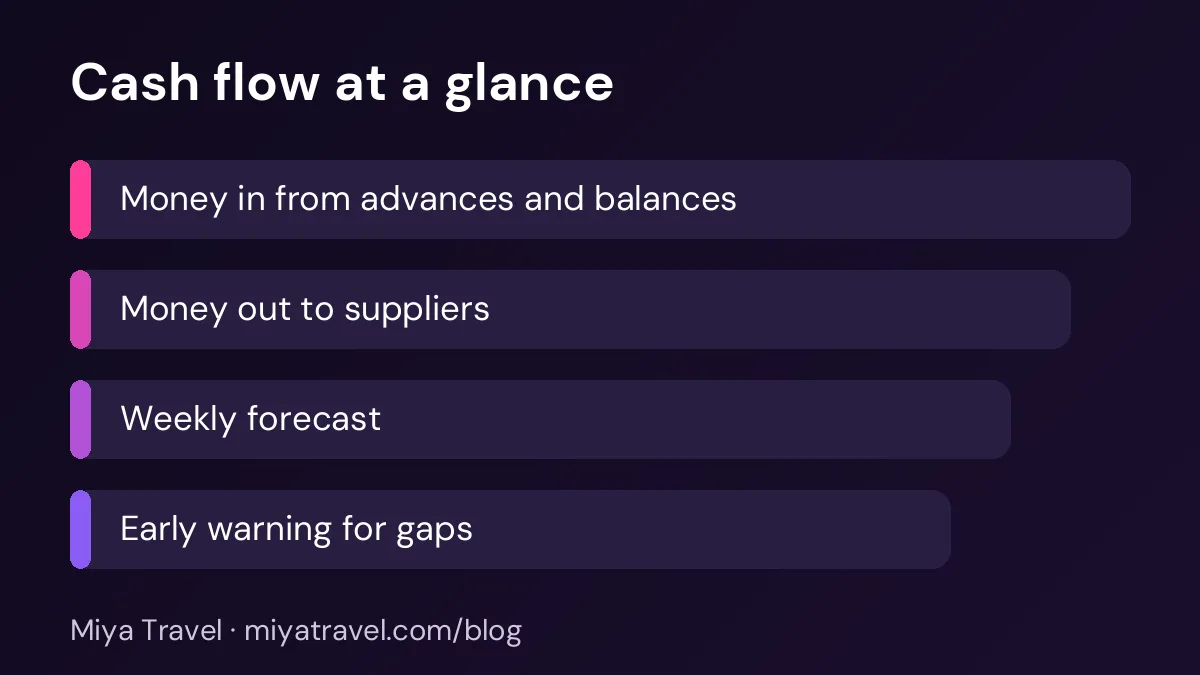
Cash flow tracking for a travel agency compares money coming in from advances and balances with money going out to suppliers and staff, week by week. A simple forecast shows when cash will be tight, so the agency can collect early, negotiate payment dates and avoid paying suppliers late.
A travel agency can be profitable on paper and still run short of cash. The reason is timing. Clients often pay part of the trip early, but suppliers may need payment before the client has paid the balance. A booking that earns a good margin can still leave the agency unable to pay a hotel on time. Cash flow tracking for a travel agency shows when money comes in and when it must go out, so the owner can plan ahead rather than react to a crisis.
This guide explains how to track cash flow each week, how to build a simple forecast and what to do when the numbers show a gap.
Why travel cash flow is different
Travel businesses have unusual timing. Clients pay advances at booking, which may be months before the trip. Suppliers may require payment at confirmation, before departure or after the trip, depending on the contract. Balances may come in late, and refunds may go out at unexpected times.
This mix means that a month can look good on revenue and still feel tight in the bank. Cash flow tracking shows the real movement of money, separate from the sales numbers.
Track money in
Money in comes from advances, instalments, balances and any other payments from clients. Record each payment on the day it arrives, with the booking reference. Group the expected payments by week, so you know how much money should arrive in the next few weeks.
Track the balances due in the next thirty days separately. These are the payments most likely to arrive, but also the ones most likely to be late. A balance due next week that has not yet been paid is a risk to plan around.
Track money out
Money out includes supplier payments, staff salaries, rent, software costs and any refunds. For each supplier payment, record the amount, the due date and the booking it relates to. A supplier payment due next week is a fixed commitment that must be planned for.
Keep the supplier payment terms in the record too. Some suppliers allow thirty days after the trip, while others need payment at confirmation. Knowing the terms helps you plan the cash you need.
Pay suppliers on their due dates, not earlier unless you have a reason. Paying early can drain cash that you need for another booking, and paying late can damage your relationship and your terms.
Build a simple weekly forecast
A weekly forecast is a table with the next eight to twelve weeks across the top and rows for money in, money out and the closing balance. Fill in the expected payments from the booking records and the supplier due dates. Start with the cash you have today.
The forecast does not need to be perfect. Its purpose is to show gaps early. If the closing balance falls below a safe level in week six, you have time to collect payments, negotiate a supplier date or delay a non-essential cost.
Set a minimum cash level
Agree a minimum cash level with the owner. This is the amount the agency should always hold to cover supplier payments and salaries for a set period. When the forecast shows the balance falling below this level, the team should act. Actions might include chasing overdue balances, asking clients for earlier payment on new bookings or reviewing the timing of supplier payments.
Write the minimum level on the dashboard, so it is visible each week.
Collect balances early
The fastest way to improve cash flow is to collect balances on time. Send reminders before the due date, not after. Call clients whose balance is more than a week overdue. For corporate clients, confirm the payment date with the accounts contact and record the agreed date.
Consider asking for a slightly higher advance on large bookings, especially for international trips with high supplier costs. This protects the agency if the client cancels, and it improves cash flow from the start.
Handle refunds carefully
Refunds reduce cash and can arrive at unexpected times. When a client cancels, check the cancellation terms and calculate the refund before you pay it. Record the refund in the forecast, so you know when the cash will leave.
If a supplier charges a cancellation fee, make sure your client refund reflects that fee. A refund that ignores the supplier charge creates a loss that the agency must absorb.
Warning signs to watch
Several signs point to cash trouble. Balances are increasing and not being collected. Supplier payments are being delayed. The forecast shows the balance falling below the minimum for two or more weeks. Large bookings are confirmed with low advances. Each sign deserves a decision, not just a note.
Review the warning signs each Monday. If two or more appear, call a short meeting with the owner and the accounts person to agree the action for the week.
Common mistakes
The first mistake is tracking revenue but not cash. The second is no forecast, so gaps appear without warning. The third is paying suppliers early without checking the cash position. The fourth is ignoring overdue balances because the client is valuable. The fifth is forgetting refunds and cancellation charges in the forecast.
Another mistake is treating cash flow as the accountant's job alone. The owner needs to see it weekly, because decisions about bookings and suppliers depend on it.
Using a tool or a sheet
A spreadsheet is enough for a small agency. Use one tab for money in, one for money out and one for the forecast. Update it every Monday. A dashboard with the cash position, the balances due and the supplier payments due next thirty days is a useful summary.
If you use software, check that it records payments and due dates clearly, and that it can show a forecast or export the data for one. Our accounting software guide explains what to check. Miya Travel focuses on the sales side, so check the documentation for the current features before you rely on a specific cash report.
A simple Monday routine
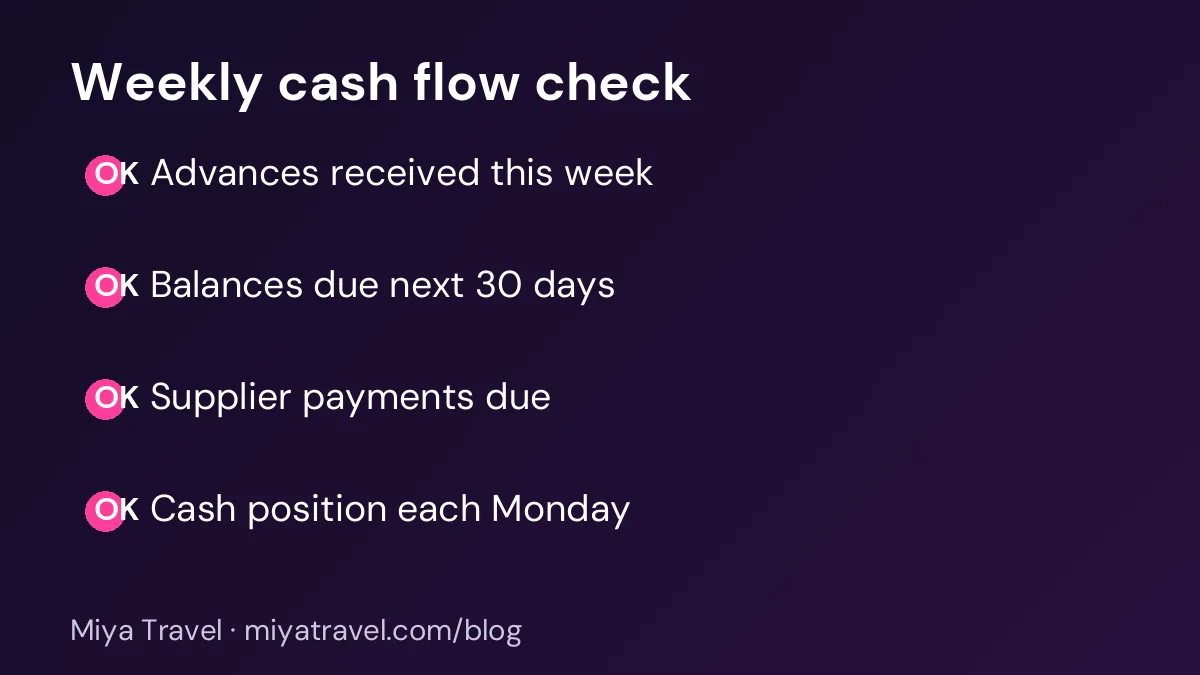
Each Monday, record the payments received last week, update the balances due and the supplier payments due this month, and update the forecast for the next eight weeks. Check the closing balance against the minimum level. If a gap appears, agree the action for the week and assign an owner. This routine takes about thirty minutes and prevents most cash surprises.
Planning for the peak and quiet seasons
Travel businesses have strong seasons, and cash moves with them. In peak season, bookings and advances rise, but supplier payments also rise, and the margin on each trip may be smaller because prices are high. In quiet months, bookings slow down, but fixed costs such as salaries and rent continue. A cash plan should cover the whole year, not only the next few weeks.
Build a simple annual view. List the expected revenue by month, based on last year's pattern and the current pipeline. List the fixed costs and the expected supplier payments by month. Compare the two, and find the months when cash is tight. Plan for those months in advance, perhaps by collecting advances early in the peak season or by agreeing a payment plan with a supplier.
Save some of the peak season cash for the quiet months. Agree a simple rule, such as holding a share of the peak-season margin in a separate account until the quiet period is covered. This discipline protects the agency from having to borrow at short notice.
Dealing with large single bookings
A single large booking can change the cash position for a month. A corporate event or a big group may bring a large advance and a large supplier bill at the same time. Plan these bookings separately, and check the cash impact before you confirm them.
Ask for a larger advance on very large bookings, and agree a payment schedule that matches the supplier payment dates. If the client cannot pay on schedule, reconsider whether to confirm the supplier bookings until the payment arrives. Protecting the cash position is part of protecting the business.
Frequently asked questions
What is cash flow in a travel agency?
It is the movement of money in and out of the agency over time, from client advances and balances to supplier payments, salaries and refunds.
Why can a travel agency be profitable and still short of cash?
Because clients pay at different times from when suppliers must be paid. A booking can earn margin but still leave a gap in cash if the timing does not match.
How far ahead should I forecast cash?
Eight to twelve weeks is a useful range. It shows gaps early enough to act.
What should I do if the forecast shows a gap?
Collect overdue balances, ask for earlier payment on new bookings, review supplier payment dates and delay non-essential costs if needed.
How often should cash flow be reviewed?
Every Monday, with a short review when a large booking or refund changes the picture.