
Payment tracking software for a travel agency records each advance, part payment and final balance against the booking, shows what each client still owes and sends reminders before due dates. It stops the common problem of not knowing who has paid what.
Payments are where many travel agencies lose control. A client pays an advance through a bank transfer, sends a screenshot on WhatsApp, pays part of the balance in cash at the office and asks for a receipt two months later. When the trip is near, nobody is sure how much is still due. Payment tracking software for a travel agency solves this by recording each payment against the booking, showing the balance and reminding the team before each due date.
This guide explains how to set up payment tracking, what to record for each payment and how to avoid the errors that cause disputes at the end of a trip.
Why payment tracking is harder than it looks
A travel booking often has several payments. The advance confirms the seat or the hotel room. A second payment comes before the supplier deadline. The balance is due before departure. Each payment may come from a different person, such as the client, a family member or a company accounts team. Each may be made through a different method.
Without a record, the agency relies on memory and scattered messages. Staff may believe a client has paid when the transfer has not arrived, or they may chase a client who already paid. Both mistakes harm trust.
What to record for each payment
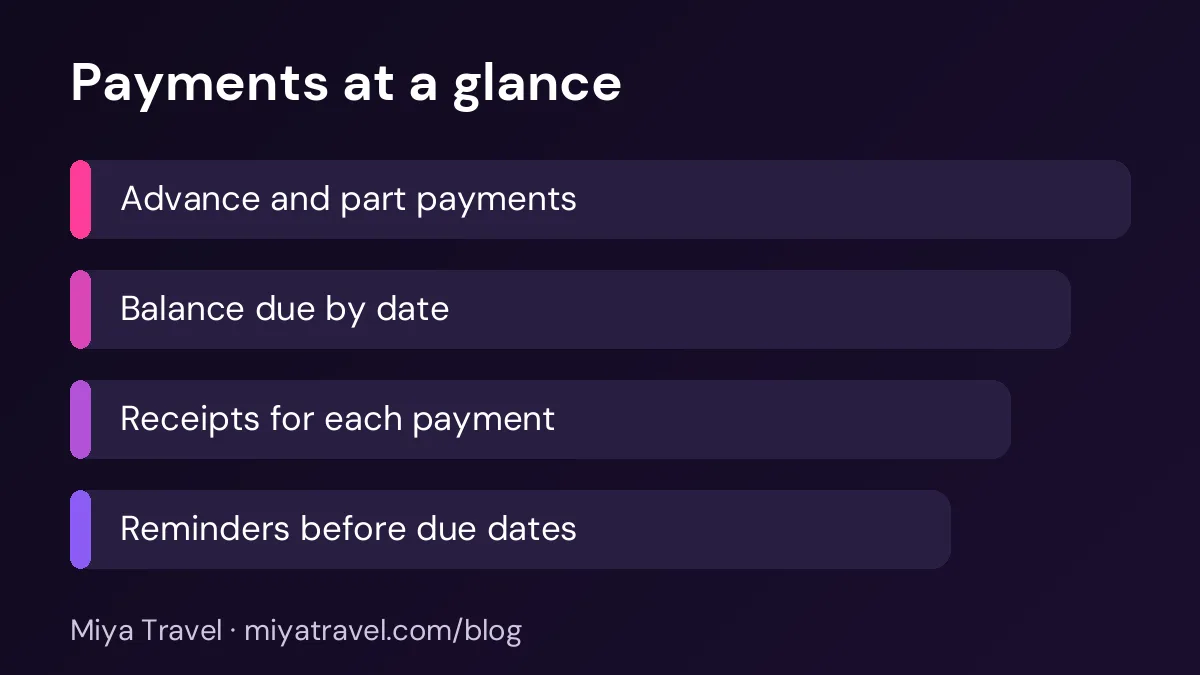
For every payment, record the date, the amount, the method, the reference number and the person who paid. The reference number is important. A bank transfer reference, a cheque number or a UPI transaction ID links the payment to the bank statement.
Attach the booking to the payment, not only the client. A client may have two bookings in the same year, and the payments must not mix. Also record the purpose of the payment, such as advance, second instalment or final balance.
Finally, record the receipt. When you send a receipt, note the date and the receipt number in the payment record. If a client asks for a copy later, you can find it in seconds.
Ask clients to use the same bank account for all payments. Mixed accounts make reconciliation slow and increase the chance of a payment being recorded against the wrong booking.
Setting payment schedules
A payment schedule should be agreed before the booking is confirmed. A common pattern is a 25 percent advance at booking, a second payment of 50 percent before the supplier deadline and the balance 15 days before departure. The exact figures depend on your supplier terms and your business model.
Write the schedule in the quotation and in the booking confirmation. Show each due date and the amount. Clients who see the full plan at the start are less likely to be surprised later.
For group bookings and corporate trips, the schedule may be different. Agree it with the group leader or the finance contact and record it in the booking.
Reminders that work
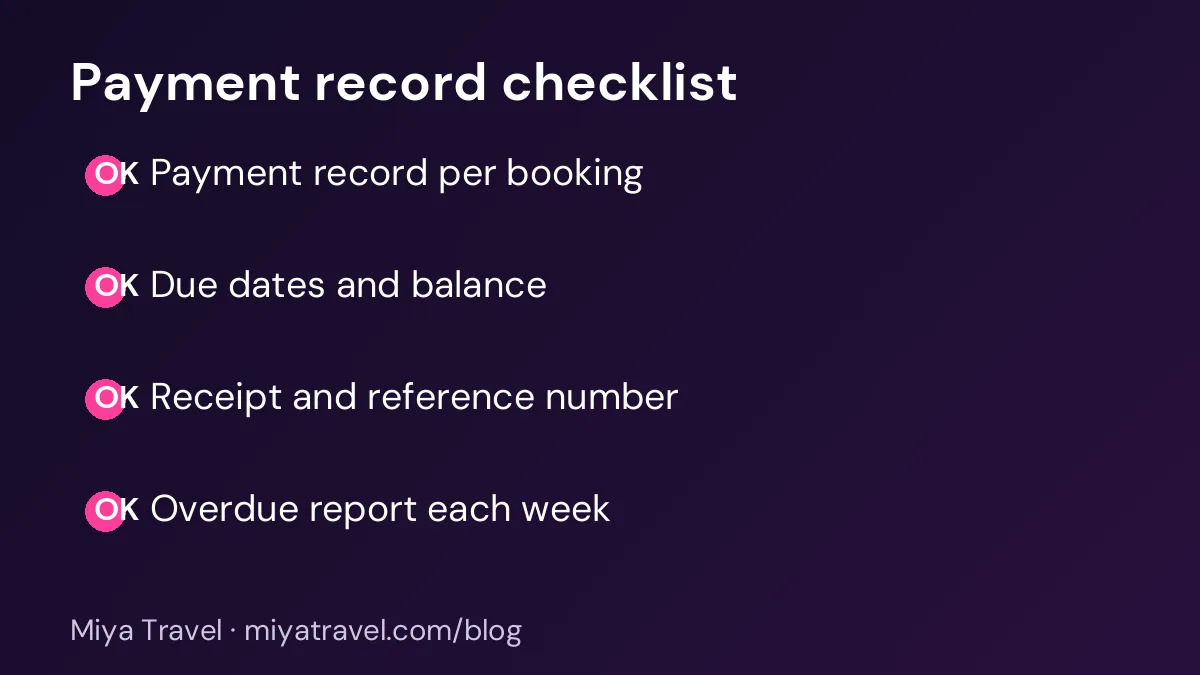
Set a reminder seven days before each due date and another on the due date. For an overdue payment, send one reminder the next day and a call after three days. Keep the message simple: the amount, the due date and the bank account or payment link.
Avoid vague messages such as "Please pay soon". A clear message with the amount and date gets a faster response. Record each reminder in the payment record so that the team knows what has been sent.
Weekly overdue report
A weekly report of overdue payments is the most useful tool you can set up. It should list each client, the booking, the amount due and the number of days overdue. Sort it by amount, so the largest balances get attention first.
Review the report with the owner each week. Decide who will call each client and by when. A short weekly routine prevents small overdue amounts from growing into large problems close to departure.
Handling refunds and cancellations
Payment tracking must also record money going back to the client. A cancellation may trigger a refund minus a cancellation charge, and the refund may be paid in instalments. Record each refund with the date, the amount and the reason, just like a payment.
Check the cancellation terms before you process any refund. The terms should match the supplier charges. If a hotel charges a fee for cancelling within seven days, your client terms should reflect that risk. Keep the written policy in the booking file.
Common mistakes
The first mistake is recording payments in a personal notebook. The second is accepting a payment without a receipt. The third is treating a partial payment as a full one and forgetting the balance. The fourth is not checking the bank statement against the records each week.
Another common mistake is chasing the wrong person. If a company pays the balance, the contact may be the accounts team, not the traveller. Record the payer's name and contact in the booking, so the reminder goes to the right place.
Choosing software for payment tracking
Look for a tool that links payments to bookings, stores receipts, shows the balance clearly and sends reminders. Ask the vendor to show a booking with three payments and one refund. The balance should update correctly, and the overdue report should show the right amount.
If the tool does not handle payments fully, you may need a separate accounting system for ledgers and tax. Confirm which part the tool covers before you plan your workflow around it. Our accounting software guide explains what to check.
Miya Travel focuses on the sales side of the agency, including leads, customers, quotations and itineraries. Check the current feature list in the documentation before you assume a payment feature exists in your plan.
A simple setup for a small agency
Create one payment record for each booking. Enter the advance on the day it arrives. Send a receipt the same day. Set reminders for the next two payments. Review overdue amounts every Monday. Reconcile the records with the bank statement at the end of each month.
This routine takes less than an hour a week for most small agencies, and it prevents the end-of-trip surprises that cost the most time and goodwill.
Accepting payments in different ways
Clients pay in many ways: bank transfer, UPI, card, cash at the office or through a relative. Each method needs a clear record. For a bank transfer or UPI payment, record the transaction reference. For a card payment, record the authorisation reference and the last four digits only. For cash, issue a receipt with a number and keep a copy. Never store full card details in a spreadsheet or a chat.
Tell clients which methods you accept, and state the details they must include when they pay, such as the booking reference. A payment with a clear reference is easy to match. A payment with no reference is harder to match and can sit unmatched for weeks.
Check any payment link or payment page before you send it. Make sure it belongs to the agency, is secure and shows the correct amount. A client who is asked to pay through an unclear link may refuse to pay, and a fraudulent link can cause serious harm to the client.
Handling payments from third parties
Sometimes a payment comes from someone other than the traveller, such as a parent, an employer or a friend. This is normal, but it must be recorded clearly. Note the name of the person who paid, their relationship to the traveller and the booking they paid for. This avoids confusion when the balance is discussed later.
For corporate payments, check whether the company requires a purchase order or an approval reference. Record that reference with the payment, so the finance team can match it to their records. A payment without the required reference may be delayed.
Frequently asked questions
What is payment tracking for a travel agency?
It is the process of recording each advance, part payment and final balance against a booking, with the date, amount, method and receipt, and showing what each client still owes.
How many payments should a travel booking have?
Most bookings have two or three payments: an advance, an optional second instalment and the final balance. The exact plan depends on your supplier terms.
What should I do if a client pays a different amount?
Record the amount exactly as received, then contact the client to agree the difference. Update the schedule in the booking so the balance is correct.
How do I track payments from a company?
Record the company contact as the payer and link the payment to the booking. Send reminders to the accounts contact, and keep the purchase order or approval reference with the payment record.
How often should I review overdue payments?
Once a week for most agencies, and every day in the two weeks before departure when payments are most urgent.