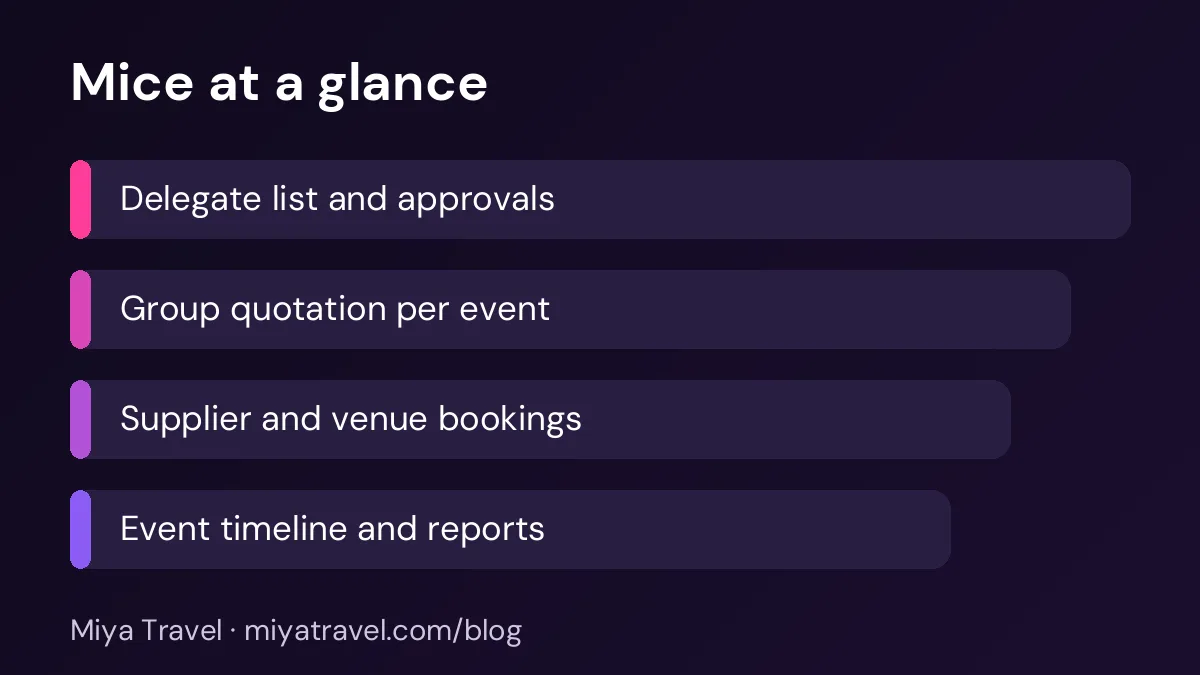
MICE travel agency software manages business travel for meetings, incentives, conferences and exhibitions. It should handle delegate lists, group quotations, supplier bookings, event timelines and approvals in one place, because MICE projects are larger and more complex than leisure trips.
MICE stands for meetings, incentives, conferences and exhibitions. It is one of the most demanding areas of travel business. A single event can involve fifty delegates, three flight groups, two venues, a welcome dinner and a final report for the client's finance team. Leisure tour tools are rarely built for this. MICE travel agency software should track each delegate, each supplier and each event milestone in one place, so the agency can deliver the event on time and on budget.
This guide explains what a MICE workflow looks like, what the software should record and how to avoid the errors that cost money on large events.
What makes MICE different
A leisure group is usually a single decision made by one leader. A MICE event often involves a client planner, a finance team, a senior approver and the delegates themselves. Each has different needs. The planner wants a clear brief, finance wants a price breakdown and approvals, and delegates want simple travel details.
MICE events also have fixed deadlines. A conference venue needs a headcount before a certain date. A flight block has a cutoff. An incentive trip may depend on a sales target that is measured months in advance. The agency has to track all these dates together.
The MICE workflow in six stages
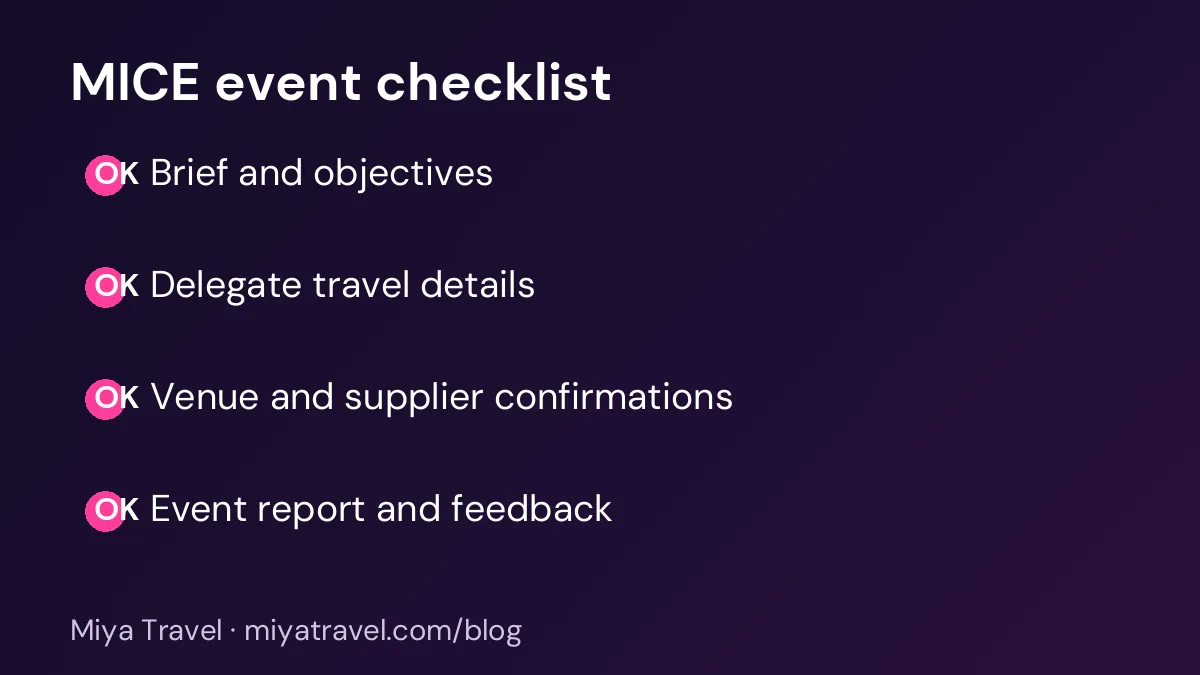
The first stage is the brief. Record the purpose of the event, the dates, the number of delegates, the budget range and the approval process. Confirm who signs off the final quotation.
The second stage is the proposal. Create a quotation with a clear breakdown of venue, travel, accommodation, meals, transport and the agency fee. Show the price per delegate and the total for the event. Include options if the client can choose between two venues or two hotel categories.
The third stage is the confirmed event. Once the client approves, record the supplier bookings with reference numbers and deadlines. Track the venue, hotels, transport, catering and any speakers or guides.
The fourth stage is delegate management. Collect the names, travel dates, passports or identity documents and any special needs. Check each delegate's details against their documents before you book flights.
The fifth stage is the event itself. Create a timeline for each day, with pickup times, room changes and any schedule changes. Share it with the client planner and the on-site team.
The sixth stage is the close. Collect the final payment, reconcile supplier invoices and send the event report with the cost summary. A short feedback form helps you improve the next event.
Ask the client planner for one approved brief document before you start. Most MICE disputes come from different people remembering different requirements.
Features the software should cover
Look for a delegate list that can store names, travel details, documents and special requirements. A spreadsheet can do this for a few delegates, but it becomes unreliable at scale. The software should allow you to update the list quickly and share a copy with the client.
Group quotations should show price per delegate and allow options. The tool should also keep the quotation linked to the event so that changes are easy to track.
Supplier tracking matters because MICE events depend on many suppliers. Record each supplier, the confirmation number, the deadline and the amount. Set reminders for deadlines, so that the team does not miss a cutoff.
Finally, look for timelines and reports. A timeline gives the on-site team a single view of the event. A report gives the client a clear summary of what was delivered and what it cost.
Managing approvals
Corporate clients often need approvals at several levels. The planner may approve the brief, the finance team may approve the budget and a senior manager may approve the final list. Record each approval with the date and the name of the approver.
If a delegate list changes after approval, record the change and get written confirmation. Verbal changes cause disputes when the invoice arrives.
Budget control on large events
A MICE budget can move quickly. A venue upgrade, an extra night for ten delegates or a change in flight times can add thousands of rupees. Track the budget against the approved quotation at each stage, not only at the end.
Set a contingency line in the budget, typically a small percentage of the total, and explain it to the client. This makes unexpected costs easier to approve.
Common mistakes
The first mistake is starting bookings before the headcount is firm. Ask for a headcount date and confirm supplier change deadlines before you book.
The second mistake is missing passport or visa details for international delegates. Check documents early, because some visas take weeks.
The third mistake is sending the final timeline late. The on-site team needs it at least a week before the event.
The fourth mistake is not reconciling supplier invoices with the client quotation. Mismatches are much harder to explain after the event than before it.
Managing the on-site team
On the day of a MICE event, the agency's on-site team needs one clear source of truth. A printed timeline with room numbers, transport slots and contact names prevents most problems. Give each on-site staff member a copy and keep a master version with the agency's operations lead.
Set up a simple check-in process for delegates. Use the delegate list to confirm arrivals, note any missing passengers and report them to the operations lead within the hour. If a flight is delayed, the on-site team should know before the transfer driver does.
Record every change made during the event, with the time and the reason. A change to the dinner venue at six in the evening should appear on the master timeline before the first delegate sees it. This record helps you explain the final invoice and improves planning for the next event.
How a travel CRM helps MICE sales
A CRM helps with the sales side of a MICE event. It records the enquiry from a corporate client, the proposal, the follow-up and the decision. It also keeps the client's history, so the next event starts with the lessons from the last one.
Miya Travel supports leads, customers, quotations and itineraries for the sales stage of a group or corporate trip. Check the current feature list in the documentation before you rely on a specific MICE function, and confirm any event-specific needs with the team.
A simple MICE template
Create a template for each type of event you run often, such as an incentive trip, a conference or an annual sales meeting. Include the standard brief, the approval steps, the delegate form, the supplier checklist and the report format. Each new event starts from the template and changes only the details.
Templates reduce mistakes and make it easier to hand an event to another team member.
Working with the client planner from start to finish
The client planner is the person who brings the event to your agency and who answers for it inside their own company. They may be an events manager, an HR lead or an executive assistant. Build a strong working relationship with this person, because they control the approvals, the budget and the final decision.
Agree the communication rhythm early. A weekly call during planning, a daily check in the final two weeks and a clear escalation path for urgent issues will keep the event on track. Record each agreed decision in writing after the call, and ask the planner to confirm it by email.
Be honest about risks. If a venue is nearly full or a flight price may rise, tell the planner early and offer options. A planner who hears bad news early can make a decision in time. A planner who hears it at the last minute will remember the surprise, not the solution.
Measuring the success of an event
After each MICE event, measure what went well and what did not. Useful measures include the number of delegates who attended on time, the number of complaints received, the accuracy of the final invoice against the approved quotation and the feedback score from the planner.
Share the measures with the planner in a short report. A clear summary shows the value of your work and gives the planner evidence for the next event. Keep the same measures for each event, so you can see trends across the year.
Use the findings to improve the template. If an airport transfer caused the most complaints, change the transfer plan for the next event. If the final invoice was often higher than the quotation, tighten the change control process. Each event should make the next one smoother.
Frequently asked questions
What is MICE travel?
MICE travel covers business travel for meetings, incentives, conferences and exhibitions. These events usually involve large groups, multiple suppliers, approvals and fixed deadlines.
What should MICE software track?
Delegate details, group quotations, supplier bookings and deadlines, approvals, event timelines and final reports.
How early should I confirm a MICE headcount?
Confirm it as early as the supplier allows, and check the change deadlines before you book hotels, venues and flights.
How do I handle changes after approval?
Record each change with the date, the reason and the cost effect, and get written confirmation from the client planner before you act.
Do MICE events need a final report?
Yes. A report with the cost summary and the delivery of each stage helps the client's finance team close the event and helps you plan the next one.