Group tour booking software keeps a group's passenger list, quotation, deposits, rooming and departure details in one record. It saves time on large groups, where a single change can affect many passengers, rooms and suppliers at once.
A group tour is a different job from a family holiday. One enquiry can mean twenty or forty passengers, several room types, a coach, a guide and a payment plan split into three dates. A single change, such as a passenger dropping out or a hotel moving, touches every part of the booking. Group tour booking software keeps all of this in one record so the agent can manage the group without rebuilding the sheet each time.
This guide explains how group bookings work, what the software should track and how to avoid the errors that create extra costs.
Why groups need their own process
A couple buying a holiday package makes one decision. A school or a religious group often has a leader who collects money, a set of passengers who each need documents, and a few members who change their minds. The agent must keep track of each person while keeping the group price right.
Groups also bring a higher risk. A block of hotel rooms is often booked before the final list is known. If the list changes after the hotel deadline, the agency may pay for empty rooms. Good records help you avoid this.
What to track for every group
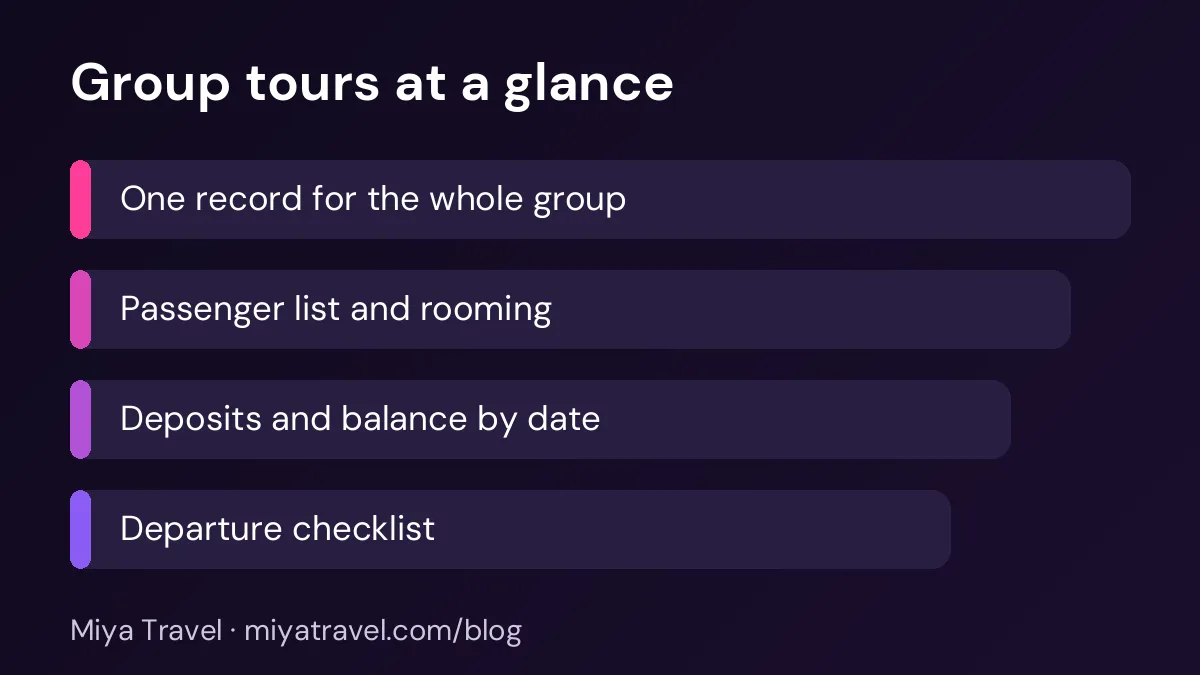
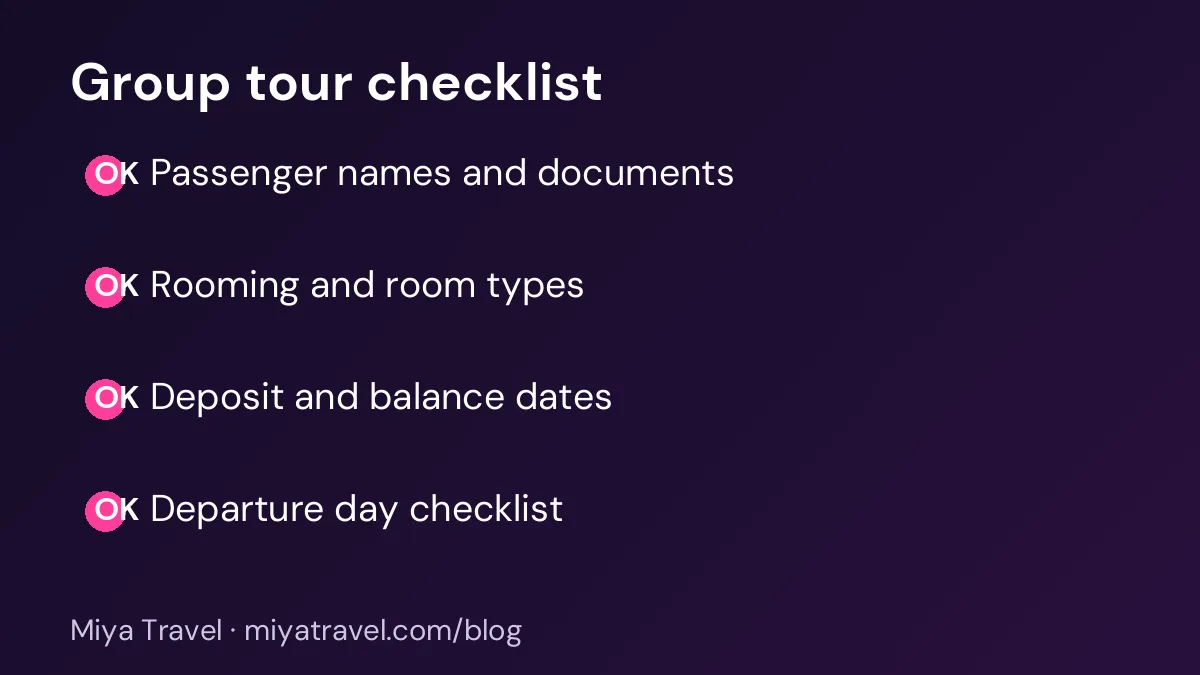
Start with the group leader's contact details, the travel dates and the destination. Then record the passenger list with names exactly as they appear on identity documents. Add ages where it matters for pricing, such as children or senior citizens, and note any dietary or medical needs that the operator should know.
Next, track rooming. Record the number of single, double and triple rooms, and who shares with whom. Keep the room type and hotel name with each booking. Finally, track the payment plan with the amount and due date for each deposit and the final balance.
Ask the group leader to confirm the passenger list in writing, with names as they appear on passports or IDs. Most rework in group bookings comes from spelling mistakes in the first list.
A workflow from quote to departure
The first step is the group quotation. Calculate the price per person with a clear breakdown of accommodation, transport, sightseeing and the agency margin. Show the inclusions and exclusions, and state the minimum group size if the price depends on it.
The second step is the booking. Once the group confirms, collect the deposit and create the booking record. Reserve the hotel rooms and transport, and note the supplier reference numbers. The third step is the passenger list. Collect documents and check names against them. The fourth step is the balance and final numbers. Collect the balance before the deadline and confirm the final headcount with suppliers.
The last step is the departure checklist. Confirm pickup times, the guide, the coach number and the emergency contact. Send the final itinerary and the group leader's contact details to every passenger.
How to price a group tour clearly
Groups often negotiate, and a clear price breakdown makes the negotiation easier. Show the cost per person for each major item, then show how the price changes with group size. A group of twenty may get a better hotel rate than a group of ten, and that should be visible.
Avoid hiding the margin inside a single price. The group leader does not need your margin, but your team does. Record the cost, the selling price and the margin for each group, so that you can tell which groups are profitable.
Managing changes without losing money
Changes are normal in groups. A passenger cancels, a family adds two members, or a parent asks to travel with a different child. Each change should be recorded on the booking with the date, the reason and the effect on price.
Check your cancellation terms before you accept a change. Some suppliers charge if you reduce rooms after a deadline. Some clients may need to pay a penalty under your policy. Put the rules in writing at the start, so that the group leader knows them.
Keep a record of every change request. When a dispute comes up after the trip, a clear log is the best evidence you have.
Common mistakes
The first mistake is working from a spreadsheet that different staff members update in different ways. Two copies of the same list will drift apart within a week. Keep one master record for each group.
The second mistake is confirming rooms before the passenger list is final. Ask suppliers about change deadlines and confirm rooms only when you know the list is close to final.
The third mistake is leaving the group leader to collect money without a record. Track every deposit with the date and the person who paid, so that the balance is always correct.
Collecting payments from a group leader
Most group bookings are paid by one person who collects money from the others. This is convenient for the agency but risky if the leader does not keep records. A missing deposit or a wrong amount can delay the booking and cause stress for everyone.
Set a payment schedule in writing at the start. For example, twenty percent at confirmation, another thirty percent by a fixed date and the balance two weeks before departure. Give the leader a receipt for each payment, and keep a copy in the group file. Ask the leader to confirm each transfer by sending the reference number. When a passenger pays the leader directly, ask the leader to forward the amount and the name of the passenger within a day.
If a passenger misses a payment, contact the leader first, not the passenger. The leader knows the group and can usually resolve the issue faster. Record the agreed date for the missed payment and what happens if it is not paid, such as the seat being released.
Group tours and a travel CRM
A travel CRM helps with the sales side of a group. It tracks the enquiry, the quotation and the decision. It can also link the group to a customer record, which is useful for repeat groups such as a school that travels every year or a company that books an annual offsite.
Miya Travel supports leads, customers, quotations and itineraries, which cover the sales steps for a group. For passenger rooming and supplier tracking, check the feature list in the documentation or confirm the details with our team before you rely on them.
A simple group template
Create one template for each type of group you sell often, such as pilgrimage, school, or corporate. Include the standard inclusions, the payment plan, the cancellation terms and a passenger form. Each new group starts from this template and changes only the dates, the destination and the price.
Templates reduce mistakes because the terms are the same every time. They also make it easier to train new staff.
Dealing with groups that change plans
Group plans rarely stay fixed. A school may change its dates after a parent meeting, a company may add a few senior staff at the last minute, or a religious group may shift its route because of weather. These changes are normal, but they need a calm and structured response. The first step is to confirm exactly what has changed, in writing, with the group leader.
Once the change is clear, check its effect on every supplier. A change in headcount affects rooms, seats, meals and transport. A change in dates affects every booking in the group. Make a list of the suppliers affected, the new numbers and the deadline for each change. Some suppliers will accept changes until a set date, and others will charge a fee for late amendments.
Prepare a revised quotation that shows the price effect of the change. Keep the original and the revised version on file. Explain the difference clearly to the group leader, and give them a deadline to accept the revised version. A clear process turns a stressful change into a manageable task.
Protecting the agency on large groups
Large groups carry more financial risk than individual bookings. A single cancellation can affect many rooms, and a supplier may hold the agency responsible for a block booking. Protect the margin by agreeing clear cancellation and change terms with the group leader before any supplier booking is confirmed.
Ask the group leader to sign the terms, or to confirm them by email. State the deposit that is non-refundable, the dates after which changes incur charges and the minimum number of passengers that the price depends on. These terms should match what your suppliers require, so that the agency does not absorb costs it did not agree to.
Review the group's risk at each stage. A group that has paid a deposit and confirmed its passenger list is lower risk than one that has only made an enquiry. Adjust your supplier commitments to match the stage, and do not confirm large room blocks until the risk is acceptable.
Frequently asked questions
What is group tour booking software?
It is software that keeps a group's passenger list, rooming, quotation, deposits, changes and departure details in one record, so the agent does not have to track each passenger in a separate sheet.
How many passengers make a group tour?
Most agencies treat a booking of ten or more passengers as a group, but the exact number depends on your business. What matters is that the booking needs a passenger list, rooming and a payment plan.
When should I confirm hotel rooms for a group?
Confirm rooms when the passenger list is close to final, and check the supplier's change deadline first. Booking too early can leave you with empty rooms and costs.
What should a group quotation include?
A clear price per person, the inclusions and exclusions, the minimum group size if the price depends on it, the payment plan and the cancellation and change terms.
How do I handle a passenger who cancels?
Record the change, check the cancellation terms with the supplier, apply your own policy and tell the group leader the effect on the price.