A corporate travel agency CRM keeps each business client as an account with several contacts, travel policies, approval rules, repeat trip history and monthly billing details. It helps the agency serve companies consistently, even when many employees book different trips throughout the year.
A corporate client is not a single customer. It is a company with several contacts, a travel policy, approval rules and a steady stream of trips. One employee may book a flight to Mumbai on Monday, a team may travel to Bengaluru next month and a senior manager may need a last-minute trip to Dubai. The travel agency has to serve all of them consistently while keeping the company's rules and budget in mind. A corporate travel agency CRM is built for this kind of account.
This guide explains how to set up a corporate account, what to record for each company and how to keep the relationship strong over many trips.
Think in accounts, not individual bookings
In a leisure business, each booking often stands alone. In corporate travel, the company is the account, and every booking belongs to it. This changes how the CRM should be organised. The main record is the company, with its contacts, policy, approvers and history. Each trip links back to that account.
This structure helps the team see the full relationship. The agency can tell how many trips the company booked last year, which routes are most common and which employees travel most often.

What to record for each corporate account
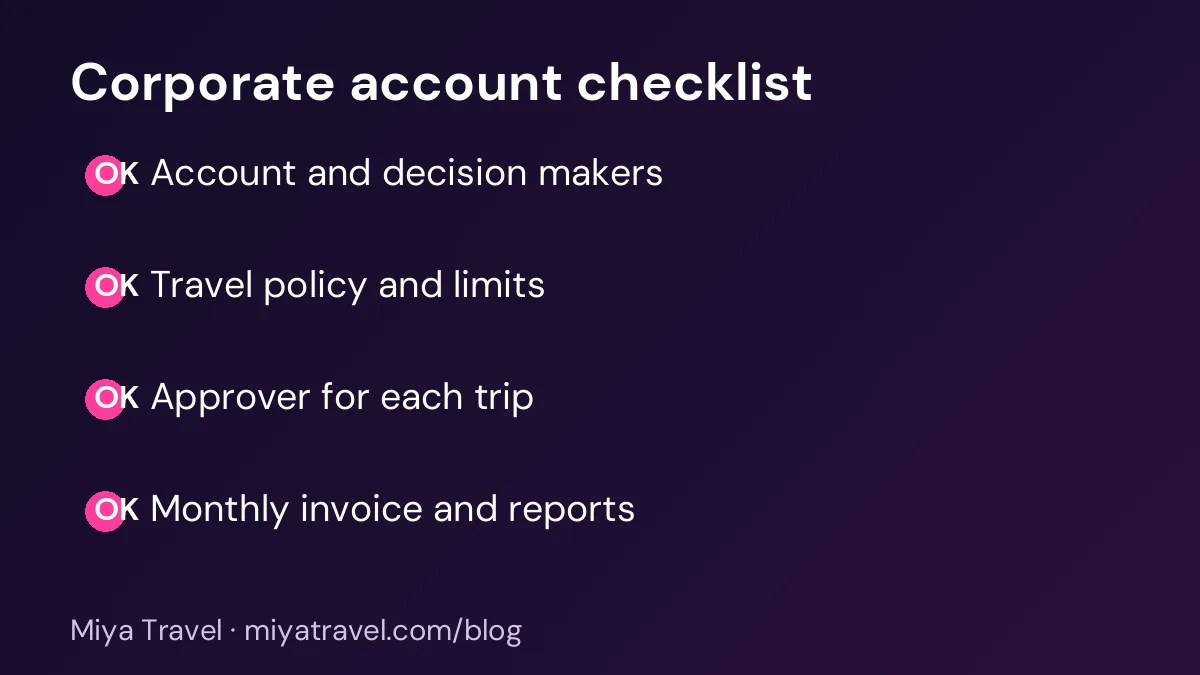
Start with the company name, address, the registration details your invoicing requires and the main contact. Then list the people who matter: the travel coordinator who books trips, the approver who signs off trips, the finance contact who pays invoices and the employees who travel most often.
Record the travel policy as a short document or a summary. Include the preferred airlines, hotel categories, daily allowances, the approval limit for each trip and any rules about advance booking. Keep the policy in the account, so that every agent follows the same rules.
Ask the company for its travel policy in writing at the start. Agents who work from memory make small mistakes, such as booking a higher hotel category than the policy allows, and these mistakes are expensive to correct.
Approval steps
Many companies require approval before a trip is booked. Record the approver for each employee, the approval limit and the method of approval, such as email or a form. When a trip request arrives, the agent should check that approval is in place before confirming the booking.
If the approval is missing, the booking should wait. Confirming a trip without approval can lead to disputes about who pays, and the agency may be left with the bill.
Managing repeat trips
Corporate clients travel often, so repeat trips are the core of the business. Record each trip on the account with the employee, the route, the dates, the cost and the supplier. Over a year, this history shows the company's travel pattern. You can use it to negotiate better rates, plan for busy periods and suggest preferred suppliers.
Repeat trips also make the agent's job easier. When an employee books a familiar route, the agent can check the last trip in seconds and reuse the right details.
Billing and monthly reporting
Most corporate clients prefer one monthly invoice that lists all trips, not an invoice for each booking. Set up the invoice cycle in the account, with the billing contact, the payment terms and the format the finance team needs. Include the trip, the employee name, the cost and the tax details.
A monthly report helps the finance team check the spend against the budget. Send it before the invoice, so that questions can be answered before payment is due.
Service levels and contacts
Agree a service standard with the company. For example, a booking request should be answered within two hours during working hours, and urgent changes within thirty minutes. Record the standard in the account, so that the whole team follows it.
Keep a list of after-hours contacts for urgent problems. A flight cancellation at night is a common corporate emergency, and the company expects a quick response.
Relationship management
Corporate relationships depend on trust and consistency. Review the account every quarter. Look at the number of trips, the total spend, any service problems and the company's feedback. A short review meeting once or twice a year helps you spot new opportunities, such as a new office or a new route.
Ask the travel coordinator for feedback on each trip. Small comments, such as a preference for an earlier flight or a complaint about a driver, help you improve the service before the next trip.
Common mistakes
The first mistake is no written policy, which leads to inconsistent bookings. The second is missing approvals. The third is billing each trip separately when the company expects a monthly invoice. The fourth is a single contact at the company, which creates risk if that person leaves. The fifth is ignoring repeat trip data, which means the agency misses chances to offer better service.
Another mistake is treating a corporate account like a leisure customer. Corporate travellers often want speed, reliability and clear records more than a personal touch, so adjust the service accordingly.
Choosing a corporate CRM
Look for a tool that holds the company as an account, links contacts and approvers, stores the travel policy and records each trip against the account. Ask the vendor to show an account with several employees, an approval step and a monthly invoice list.
Check how the tool handles team access. Account managers may need full access, while booking agents may need only the trips they handle. Confirm that the roles match your team structure.
Miya Travel includes customer records, quotations, itineraries and team roles, which help the sales side of a corporate account. Check the roles and permissions documentation and confirm any corporate billing features you need before you plan around them.
Winning and keeping a corporate account
Corporate accounts usually start with a tender, a referral or a single trip that goes well. Treat the first trip as the start of a long relationship. Ask for feedback from the travel coordinator and the employee, and act on it quickly. A company that sees fast improvement after feedback is more likely to give the agency a larger share of its travel.
Prepare a short account proposal for each corporate client. It should explain your service standards, your response times, your approach to approvals and billing, and the way you handle emergencies. Include two or three examples of similar clients you serve, without naming confidential details. A clear proposal shows the procurement team that the agency is organised.
Build a simple service calendar. Schedule a short check-in each month with the travel coordinator, a quarterly review of spend and service, and an annual review of the agreement. These regular contacts keep the account visible and surface problems before they become complaints.
Respect the company's data. Corporate travel records contain employee details, passport information and sometimes sensitive travel patterns. Limit who in your team can see the account, and make sure data is shared only with the people the company has named.
Handling corporate emergencies
Corporate travel often involves urgent changes. A senior manager may need a flight the same day, or a team may be stranded after a cancellation. Agree an emergency process with the client in advance. Name the agency contact who answers calls at any hour, and state how quickly you will respond.
Prepare a short emergency checklist for the team. It should include the traveller's full name, the booking reference, the alternative flights to check, the hotel contact and the approver who can authorise extra spend. A checklist keeps the response calm and fast, even under pressure.
After each emergency, record what happened, what was done and how long it took. Share the summary with the client. A clear account of how the problem was handled shows reliability and gives you material for improving the process.
Frequently asked questions
What is a corporate travel agency CRM?
It is a CRM built around company accounts, with multiple contacts, travel policies, approvals, repeat trip history and monthly billing support.
Why should corporate clients be set up as accounts?
Because many employees book trips for one company, and the agency needs to see the full relationship, the rules and the spend in one place.
How should approvals be handled?
Record the approver for each employee and check approval before confirming any booking. Do not confirm a trip without the agreed approval.
Do corporate clients need monthly invoices?
Many do. A single monthly invoice listing all trips is easier for finance teams to check and pay than separate invoices for each booking.
How often should I review a corporate account?
Review the account every quarter, looking at trips, spend, service issues and feedback, and hold a short review meeting once or twice a year.