
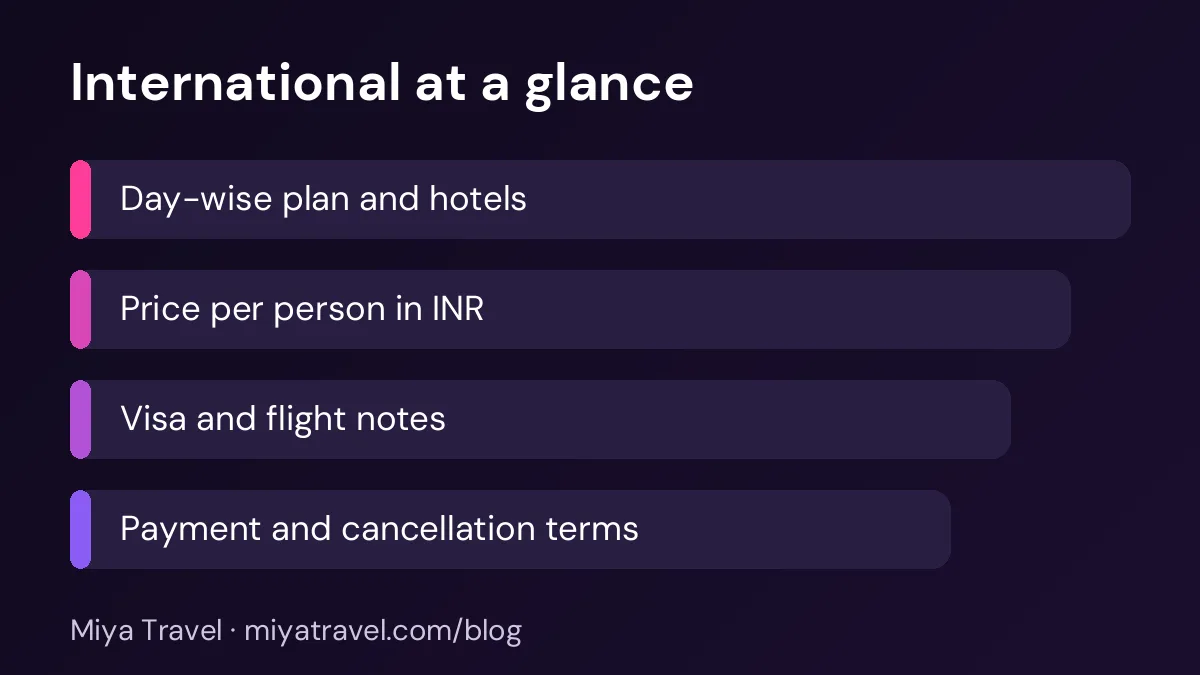
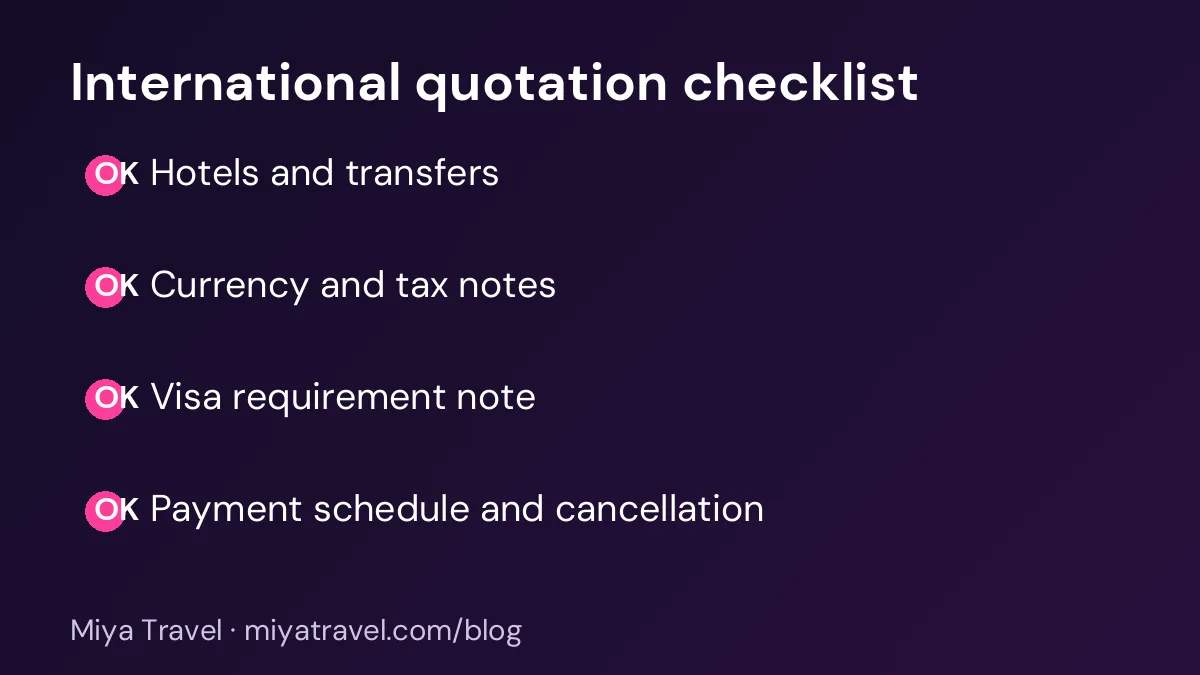
An international tour package quotation should show the day-wise plan, hotels and transfers, prices per person in a clear currency, visa and flight notes, inclusions and exclusions, and payment and cancellation terms. Clear terms protect both the client and the agency when plans change.
An international tour is a bigger promise than a domestic trip. The client is travelling abroad, the flights and visas add complexity, currency and exchange rates change, and the cancellation rules are often stricter. A clear international tour package quotation helps the client understand the trip and the terms before they pay, and it protects the agency when the trip changes. This guide shows how to structure the quotation, price it clearly and state the terms in a way that reduces disputes.
Structure the quotation in a clear order
Start with the trip summary: destination, dates, number of nights, number of travellers and the room type. Then show the day-wise plan, with the city, the main activities, the hotel and the meals for each day. Keep each day short, so the client can scan the whole trip quickly.
Next, show the inclusions and exclusions, then the price, then the payment and cancellation terms, then the visa and flight notes. This order matches the questions clients ask most often, and it keeps the most important information near the top.
Be clear about flights and visas
Flights are often not included in a tour package, or they are included in a separate quotation. State this clearly. If the package includes international flights, show the airline, the class, the baggage allowance and the times, or say that the times are to be confirmed. If the flights are not included, say so in the first section of the quotation.
Visas need a clear note too. State whether the visa fee is included, who applies for the visa, and what documents the client must provide. Link to your visa document checklist so the client knows what to prepare. A visa refusal is a serious problem, so make sure the client understands their responsibility for documents.
Add a line that says the passport must be valid for a set period after the return date, as required by the destination. Clients who discover a passport problem at the airport are rarely happy, and the quotation is the first place to warn them.
Price in INR and state the currency clearly
Many international packages are priced in Indian rupees, but the supplier costs may be in dollars, euros or the local currency. Show the price in INR per person, and state the exchange rate basis if the price may change. If you hold the price for a set period, say so and state the date.
Explain the taxes and service charges as separate lines. International services often carry different tax treatment, so confirm the rules with your accountant before you finalise the format.
Describe hotels and transfers precisely
Name each hotel, give its category, and describe the room type. A "deluxe room" in one city may be a different size from another hotel's version. If the room is a shared twin, say so. Show the meal plan clearly, and note whether it is breakfast, half-board or full-board.
Show the transfers too: airport pickup, drop-off, inter-city transfers and any private or shared arrangements. A missing transfer can leave a client stranded in a foreign airport, so list every one.
Payment and cancellation terms
International bookings often need a higher deposit and a clear cancellation schedule, because supplier cancellation charges are strict. Set out the deposit, the instalments and the balance due date. State the cancellation charges by period, such as charges applied at certain days before departure.
Match your client terms with the supplier terms. If a hotel charges a fee for cancelling within a week, your cancellation terms should reflect that risk. A quotation that promises a full refund that the suppliers will not give is a serious mistake.
Travel insurance and health notes
Recommend travel insurance on the quotation, and explain what it covers in general terms. Mention any health requirements or vaccinations the destination needs, and point the client to the official travel advice. Your role is to inform the client, not to give medical advice.
Keep these notes factual and linked to official sources. Agencies that give detailed health advice without expertise can create liability.
Exclusions that protect the agency
International exclusions are important. Typical exclusions include airfare if not included, visa fees if not included, travel insurance, personal expenses, tips, optional activities, excess baggage and any costs due to flight delays or changes outside your control. State each exclusion in plain words, not in a single line that says "extras".
Change requests and fare changes
International flights and hotels can change. A change of flight time may affect the transfers, or a rate change may affect the price. State how changes are handled. For example, the agency will inform the client of any change and offer alternatives, and a price change caused by a supplier must be discussed before it applies. Clear rules reduce arguments later.
Common mistakes
The first mistake is a quotation that does not state whether flights are included. The second is unclear visa responsibility. The third is a price in one currency without a clear exchange basis. The fourth is missing transfers. The fifth is cancellation terms that do not match supplier charges.
Another mistake is copying a domestic quotation and changing only the destination. International trips need extra notes, and clients expect a more careful document.
Keeping the quotation version history
Save each version of the international quotation with the date and the reason for the change. If the client accepts a version, keep that version as the agreed quotation. When a change happens later, you can show exactly what was agreed and what changed.
Using software for international quotations
Choose a tool that builds the day-wise plan from reusable components, shows prices per person, lets you add visa and flight notes and saves each version. Ask the vendor to show a quotation with two versions and a currency note. The client PDF should match the approved version exactly.
Miya Travel supports quotations and itineraries for travel agencies. Check the quotations and itineraries documentation for current features, and confirm any currency or tax format you need with the team.
Building the package before the quotation
An international package works best when it is designed before a client asks for it. Start with the destination, the season and the traveller type, then build the day-wise plan around the places and experiences that fit. Confirm the hotels, the transfers and the activities with suppliers, and record the rates with their validity dates. A quotation built from a tested package is faster to produce and more accurate.
Test the package yourself or with a trusted local partner. Check the timings between cities, the opening hours of key sights and the realistic travel time at the airport. An international itinerary that looks good on paper can be too tight in practice, especially on the first and last days when jet lag and check-in times add pressure.
Keep the package in a library with version notes. When a supplier changes a rate or a hotel closes, update the package and note the date. The library becomes the agency's own knowledge base, which new staff can use to build quotations confidently.
Explaining the difference between packages and custom trips
Some clients want a fixed package, while others want a custom trip designed around their needs. Explain the difference clearly in the quotation. A fixed package has a set itinerary and price, with limited changes. A custom trip is built from the client's preferences, and the price reflects the choices made.
Offer both options where it makes sense. A client who is unsure can start with a package and ask for changes, and the agency can show how the price moves with each change. This transparency helps the client understand value, and it reduces the number of disputes about what was included.
Frequently asked questions
Should an international quotation include flights?
Only if you have the flights confirmed. Otherwise state clearly that flights are not included or that they are to be confirmed, and explain the next steps.
Who is responsible for the visa?
State the responsibility in the quotation. Usually the client provides the documents, and the agency applies or guides the client through the process, as agreed.
Should I show prices in INR or the local currency?
Show the price in INR for clarity, and state the exchange basis and validity period. Explain any currency-related change clearly.
What should cancellation terms include for an international tour?
The charges by period before departure, the deposit terms, the refund process and any supplier charges that apply. Match the client terms with the supplier terms.
Should I recommend travel insurance?
Yes. Recommend it clearly and explain the general cover. Do not give medical advice, and point clients to official travel information for health requirements.