
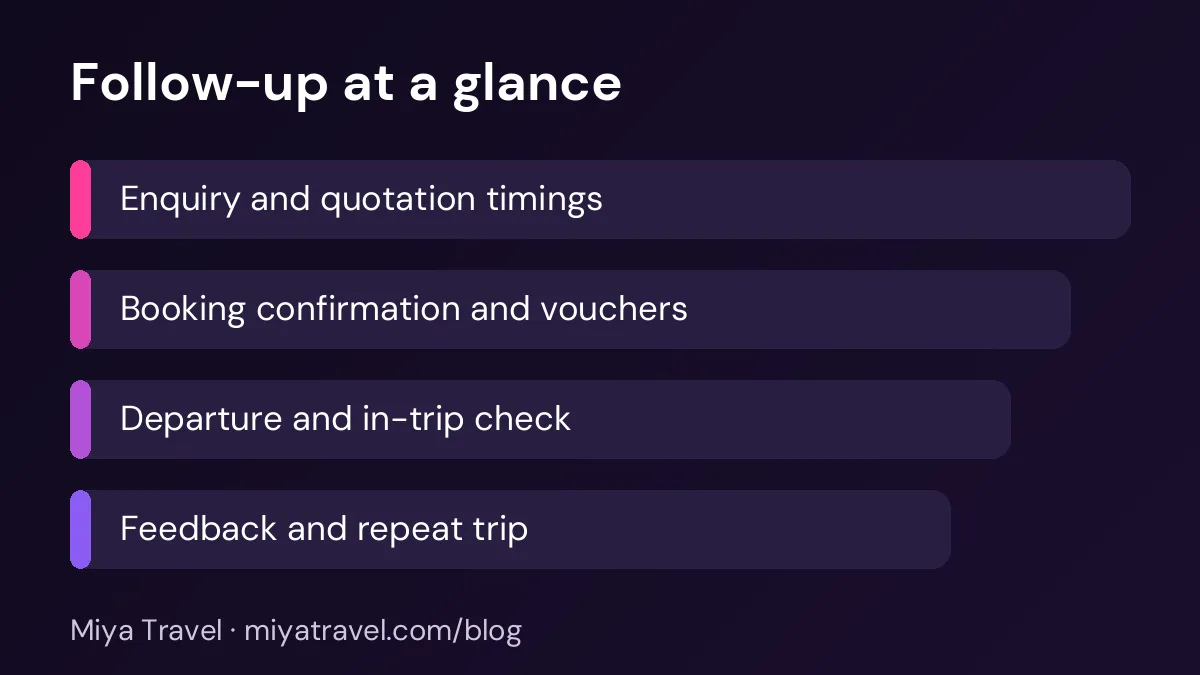
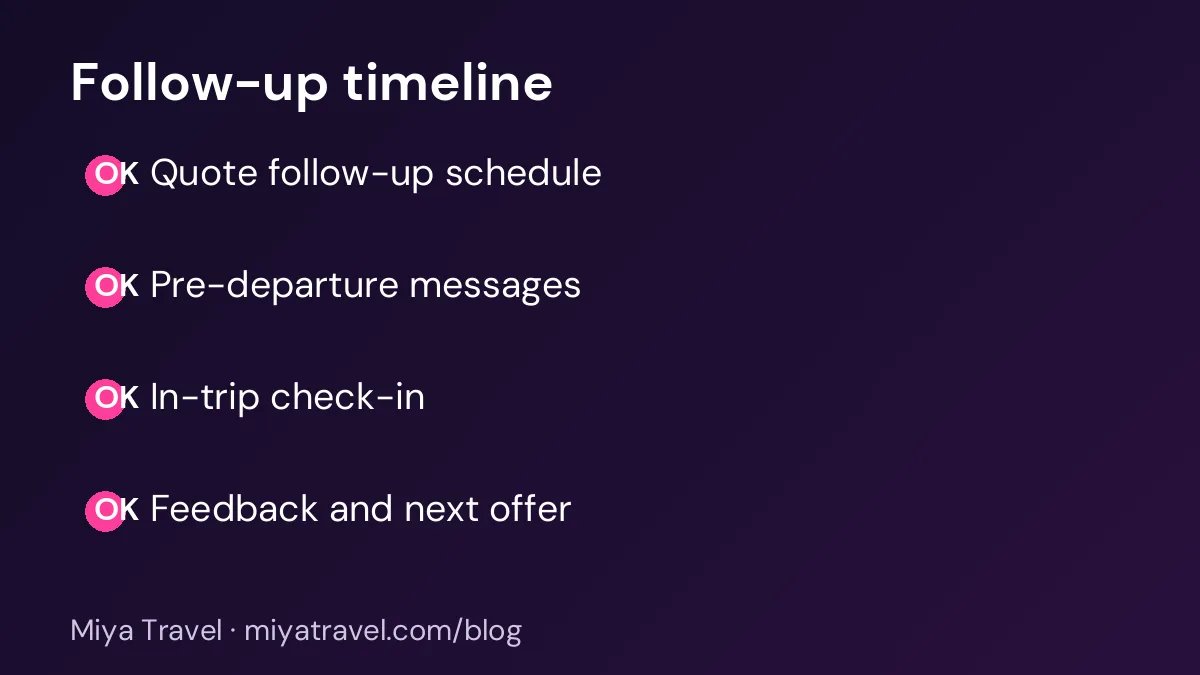
A travel customer follow-up schedule sets clear timings for each stage of the relationship, from the first enquiry through the quotation, the booking, the departure, the return and the next trip. A schedule keeps clients informed, reduces anxiety and creates repeat business without relying on memory.
A travel customer does not disappear after the booking. They want to know what happens next, they may have questions during the trip and they often plan their next holiday within months of returning. An agency that follows up with a clear schedule keeps the client informed and builds the trust that leads to repeat business. This guide sets out a complete follow-up schedule, with timings for each stage of the relationship and the purpose of each message.
Why a schedule beats memory
Without a schedule, follow-ups depend on who remembers. One agent calls the client the day before departure, another forgets, and a third sends the vouchers at the last minute. The client notices the difference, and so does the team's stress level.
A written schedule makes the process the same for every client. It also lets the owner check that the work is happening. The schedule is not a rigid rule. It is a default that the team can adjust for a particular client, but it gives everyone a starting point.
Stage 1: The enquiry
The first follow-up happens within an hour of the enquiry during working hours. The message acknowledges the enquiry and asks the key questions about the trip. Set a reminder for the agent to follow up the same day if the client has not replied.
If the client does not respond after two attempts, record the lead as contacted and set a follow-up for three days later. Keep the attempts polite and specific, so the client knows you are ready to help.
Stage 2: The quotation
Send the quotation within one working day of the qualifying call. Follow up the next working day to ask whether the client has questions. Follow up again after three days with an offer to adjust the options. After a week, send a gentle close message if the client has not replied.
Record each message in the lead, with the date and the outcome. This record helps the next follow-up feel informed rather than repetitive.
Stage 3: The booking confirmation
When the client books, send a confirmation message the same day. It should include the booking reference, the trip dates, the payment schedule and the next steps. Send the vouchers once the supplier confirmations are recorded, not before.
Set a reminder for the balance due date and for any document the client must provide. A clear message that says what is needed and by when prevents most problems at the final stage.
Stage 4: Before departure
Two weeks before departure, send a message with the final itinerary, the emergency contact and the documents checklist. One week before, confirm the pickup times, the hotel names and the flight details. Two days before, call the client to answer any questions and confirm they have everything.
On the day before departure, send a short message that wishes them a good trip and gives the emergency number. This small message is often remembered longer than the brochure.
Ask clients to save your emergency number under your agency name. When a problem happens during the trip, the client can find the number in seconds.
Stage 5: During the trip
During a long trip, check in with the client once or twice. A short message on the first morning confirms that the arrival went well. A mid-trip check-in asks whether the hotel and transfers are working. Keep these messages short, and respond quickly to any problem.
If a problem occurs, call the client rather than messaging. A call shows that you take the issue seriously, and it gives you a chance to resolve it faster.
Stage 6: After the trip
Send a thank-you message within a day of the return. Include a short feedback form with three or four questions about the hotel, the transfers, the guide and the overall experience. A feedback form is more likely to be completed if it takes less than two minutes.
Record the feedback on the customer record. If the client gives a low score, call them to understand the problem and offer a fair response. A recovery call can turn a disappointed client into a loyal one.
Stage 7: The repeat trip
Plan the next contact around the client's likely next trip. A family that travels every summer may want a message in the spring. A couple that enjoyed a beach holiday may welcome a suggestion for a similar trip. Send one useful offer, not a stream of promotions.
Set a reminder three months after the trip, asking whether the client is planning another holiday. Keep the message personal and helpful. Repeat clients are the most valuable part of a travel business, and a good schedule is how you keep them.
Common mistakes
The first mistake is no schedule, so the follow-up depends on who remembers. The second is too many messages, which feels like pressure. The third is sending the vouchers too early, before supplier confirmations are checked. The fourth is no message after the trip, which misses the chance for feedback and repeat business. The fifth is failing to record each message, so the next person does not know what was already said.
Another mistake is treating the schedule as fixed. A client who asked for fewer messages should get fewer messages. Adjust the schedule to the client, and record the preference.
Setting the schedule in your tool
Most travel tools let you set reminders and tasks for each stage. Create the schedule once as a template, and apply it when a lead changes stage. A quotation sent creates a follow-up task. A booking confirmed creates the pre-departure tasks. A trip closed creates the feedback task.
Check that the tasks appear on the owner's list as well as the agent's. The owner should see whether the schedule is being followed. Our daily follow-up guide explains how to build a routine around these tasks.
Adjusting the schedule for different clients
The default schedule works for most clients, but some need a different rhythm. A corporate travel coordinator may prefer one weekly update during a busy period. A senior traveller may welcome a phone call instead of messages. A first-time traveller may need more reassurance before departure than a repeat client who knows the process.
Record the preferred rhythm in the customer record, and apply it consistently. A client who has asked for fewer messages should receive fewer messages, even if the default schedule suggests more. Respecting the client's preference is one of the simplest ways to build loyalty.
Review the schedule each season. Ask the team which steps are most useful and which are rarely needed. A schedule that adds value for clients and avoids unnecessary messages is far more effective than one that follows a fixed script without reason.
Frequently asked questions
How soon should I follow up after an enquiry?
Within an hour during working hours, and the same day for late enquiries. A fast first reply often decides whether the client keeps talking to you.
When should I send the vouchers?
After the supplier confirmations are recorded and the payment terms are met. Sending them too early can create problems if a supplier changes the booking.
How many messages should a client receive before departure?
A few well-timed messages are enough: the confirmation, the final itinerary, the documents reminder, the pickup confirmation and the day-before message. Avoid sending more unless the client asks for them.
When should I ask for feedback?
Within a day of the client's return, with a short form of three or four questions. Follow up personally if the feedback is poor.
When should I contact a past client about a new trip?
About three months after the trip, with one relevant suggestion based on their last holiday. Repeat contact should feel helpful, not promotional.