WhatsApp follow-up templates help travel agents reply quickly and consistently, without sounding robotic. Use short templates for the first reply, the quotation follow-up, a date check, a payment reminder and a gentle close, and add one personal detail before each message is sent.
Templates save time, but they can also make an agency sound like a machine. The goal is to write messages that are quick to send and still feel personal. A good WhatsApp template gives the agent the structure, and the agent adds one detail from the client's own words before sending it. This guide gives you a set of follow-up templates for the most common stages of a travel lead, and shows you how to use them without losing the personal touch.
Keep every template short
WhatsApp is read on a phone, often between other tasks. A message that fills the screen is likely to be skimmed or ignored. Aim for two to four short sentences, one clear question and no long lists. If you need to share a quotation, send it as a PDF with a one-line message.
Short messages also get faster replies. A client who can answer with one word is more likely to reply than one who has to write a long message.
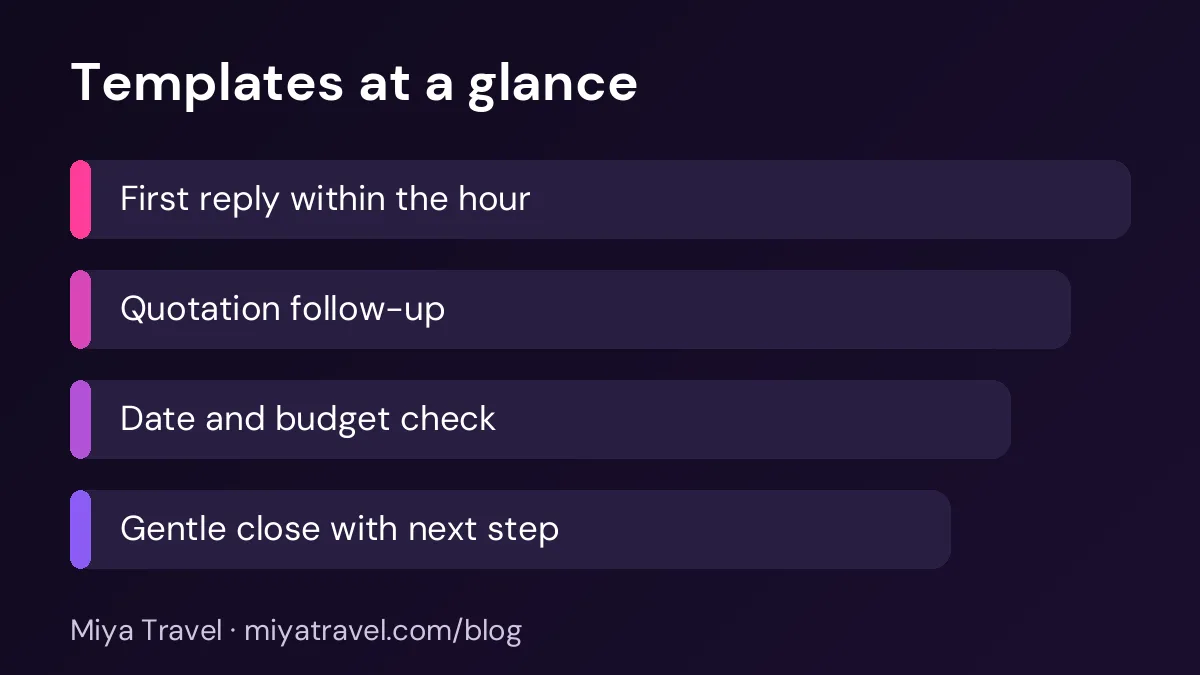
Template 1: The first reply
The first reply should arrive within an hour during working hours. It shows that the enquiry has been received and sets a clear next step. A template might read: "Hi [name], thank you for contacting [agency]. I have noted your trip to [destination] for [month]. Could you confirm the number of travellers and your budget range? I will send options today."
Replace the bracketed parts with the client's details. Keep the question simple, and promise a specific time for the next message. That promise is what makes the client wait calmly.
Template 2: The qualifying questions
When the client has not answered the first questions, send a short follow-up that asks for only the missing details. For example: "Hi [name], to plan the trip well, could you tell me your preferred dates and whether you want a hotel near the beach or in the city?" Ask no more than two questions in one message.
Asking everything at once overwhelms the client. Asking one question at a time takes too long. Two focused questions usually get the best response.
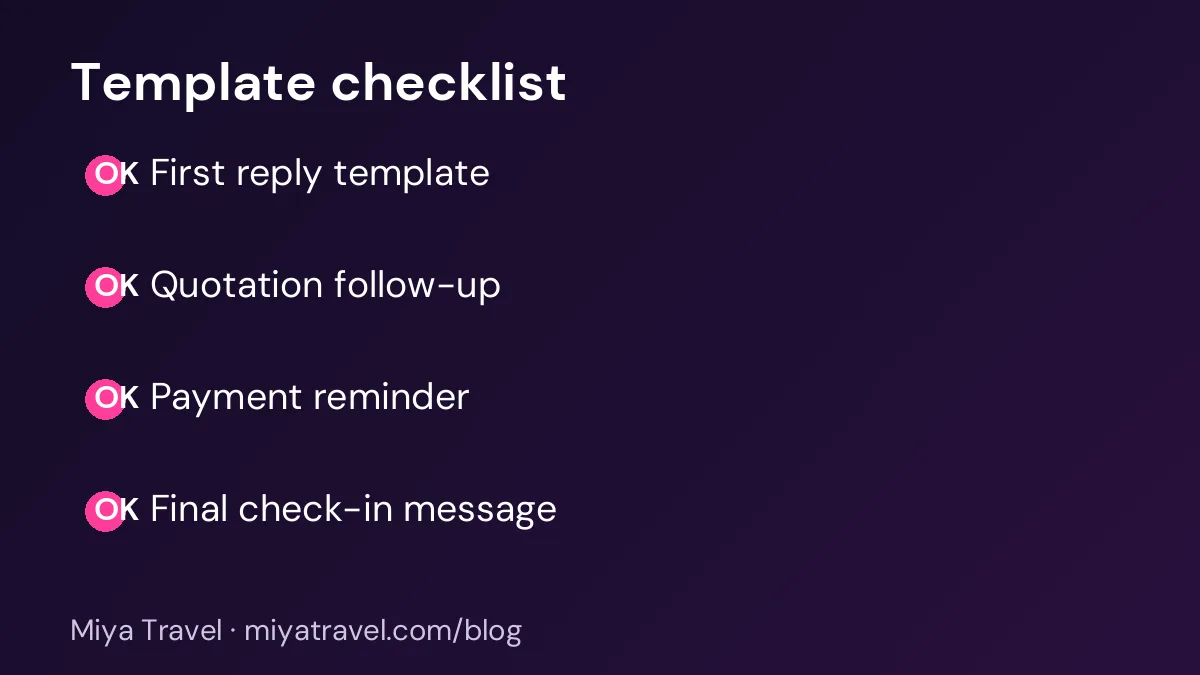
Template 3: The quotation follow-up
After a quotation is sent, follow up the next working day. A template might be: "Hi [name], I hope you had a chance to look at the quotation for [destination]. Which of the options feels closest to what you wanted? I am happy to adjust the hotel or the dates." This message refers to the quotation, invites a choice and offers help.
Avoid "Did you see my message?" It sounds like pressure. A message that offers help sounds like service.
Send the quotation follow-up at a time the client usually replies. If the client is active in the morning, send the message then. Your chat history will show you when they reply.
Template 4: The date and availability check
When a client is considering dates, a short check can move the decision forward. For example: "Hi [name], the hotel in [city] has rooms available for [dates] at the price in the quotation. Would you like me to hold them for you until [date]?" A specific hold date creates a natural next step.
Only offer a hold if the supplier allows it. Making a promise you cannot keep damages trust quickly.
Template 5: The payment reminder
A payment reminder should be friendly and specific. For example: "Hi [name], a quick reminder that the balance of ₹[amount] for your [destination] trip is due on [date]. You can pay by bank transfer to the account we shared earlier. Please send the reference once it is done." Include the amount, the date and how to pay.
Avoid words like "urgent" or "overdue" in the first reminder. A calm message gets a better response and keeps the relationship warm.
Template 6: The gentle close
Some leads go quiet. A gentle close message gives the client a clear way to end the conversation or to return later. For example: "Hi [name], I have not heard back, so I will assume you are still planning. I am happy to help whenever you are ready. If you would like me to pause this, just let me know." This message reduces pressure and often gets a reply from a client who simply forgot.
After this message, move the lead to a monthly check-in list rather than contacting the client every few days.
Make each template personal
Before sending any template, add one detail from the client's own words. It might be the name of the hotel they liked, their child's age or a festival they mentioned. A single personal detail makes the message feel written for that client.
Do not send a template without reading the last few messages. A template that repeats a question the client already answered creates frustration and looks careless.
Common mistakes
The first mistake is sending the same template to every client without changing a word. The second is too many messages in one day, which feels like pressure. The third is a message with no clear next step. The fourth is using emojis or formatting that does not match your brand, unless your team agrees on a style. The fifth is no record of what was sent, which makes the next message harder to write.
Keep a shared template library
Store your templates in one shared place, with a short note on when to use each one. Review them every month and update them when your packages, prices or processes change. Ask the team to suggest improvements, because the agents who send the messages know what gets replies.
Record the template used in the lead, so you can see which messages get the best response over time.
Using templates in a CRM
If your CRM supports templates, add them to the lead stages. A lead that moves to quoted can trigger the quotation follow-up template, and a lead that moves to won can trigger the welcome message. This keeps the process consistent and reduces the time each agent spends writing messages.
Check whether the tool lets you personalise the template before sending, because a template that cannot be personalised will sound generic. Our WhatsApp CRM guide explains how to link chats to leads.
Templates for after the trip
Most agencies write templates for the sales stage and forget the period after the trip. Yet this is when satisfied clients are most likely to refer friends and book again. Prepare three simple messages for this stage. The first is a thank-you note sent the day after the return, asking how the trip went. The second is a request for a short review, sent three or four days later, with a direct link. The third is a check-in sent about three months later, mentioning one place from their trip and offering a related idea.
Keep each message warm and brief. The thank-you note should mention a specific moment from the trip if your team recorded one, such as a favourite beach or a guide's name. The review request should explain why feedback matters in one sentence, and it should never pressure the client. The check-in should feel like a friend remembering the holiday, not a sales pitch.
Store these templates with the same care as the sales ones. Review them each season, and remove any reference to a package or price that is no longer offered. An outdated mention of a price is one of the quickest ways to lose the client's trust after a good trip.
Adapting templates for different clients
Not every client wants the same tone. A corporate travel coordinator usually prefers short, formal messages with clear facts. A family planning a holiday often responds well to a friendly tone and a question about the children. A senior traveller may prefer a phone call to a message, and a young couple may enjoy a more playful style. Keep one core template and adjust the tone for each type of client.
Record each client's preferred style in the customer record. When a new enquiry comes in, the agent can choose the right version quickly. A message that matches the client's style feels personal, even when it came from a template.
Ask the team to suggest new variations based on replies they receive. If a particular wording gets consistently warm responses, add it to the library. If a message is ignored, try a different question or a different opening line. Small tests over a few months build a strong library that reflects your real clients.
Frequently asked questions
How long should a WhatsApp follow-up message be?
Two to four short sentences, with one clear question. Short messages are easier to read on a phone and get faster replies.
How many follow-ups should I send after a quotation?
Usually one the next working day, one after three days and a final gentle close after about a week. Then move the lead to a monthly check-in unless the client asks for more contact.
Can I send the same template to every client?
You can use the same structure, but add one personal detail to each message. Templates without personal detail feel automated and get fewer replies.
Is it okay to send a payment reminder on WhatsApp?
Yes, if the client has agreed to communicate that way. Keep the message calm, include the amount and date, and explain how to pay.
What should I do when a client does not reply to a template?
Send one gentle close message, then move the lead to a monthly check-in. Pushing harder rarely helps and can damage the relationship.