
Refund tracking for a travel agency records each cancellation, the supplier charge that applies, the amount the client is owed, the date the refund is paid and the reason. A clear policy and a single record for each refund prevent disputes, protect the margin and keep the books accurate.
Cancellations are part of travel. A family falls ill, a company changes its plans or a date moves because of a festival or a flight change. Each cancellation creates a refund question, and the answer depends on the client's terms, the supplier's charges and the stage of the trip. Refund tracking for a travel agency keeps each cancellation in one record, with the charge that applies and the amount paid back, so the team handles refunds fairly and the books stay accurate.
This guide explains how to set up a refund policy, record each cancellation and avoid the disputes that come from unclear decisions.
Write a clear cancellation policy
A refund process starts with a clear policy. The policy should state the charges the agency applies at each point before departure, such as a percentage of the trip cost within certain periods. It should also explain what happens to non-refundable items, such as flights and some hotel rates, and how long refunds take.
Write the policy in plain words, and attach it to every quotation and booking confirmation. Clients who accept the policy at the start are far less likely to dispute the amount later.
Match your client policy to the supplier terms. If a hotel charges a fee for cancelling within seven days, your policy must reflect that cost, otherwise the agency pays the difference.
Record every cancellation the same way
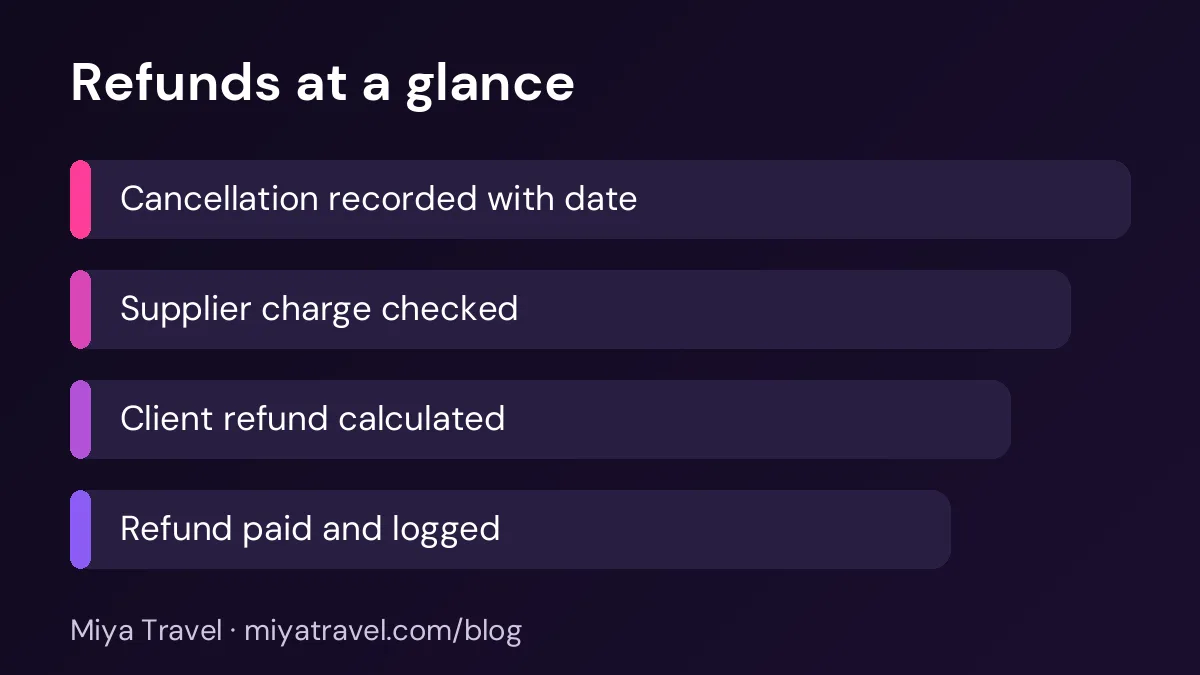
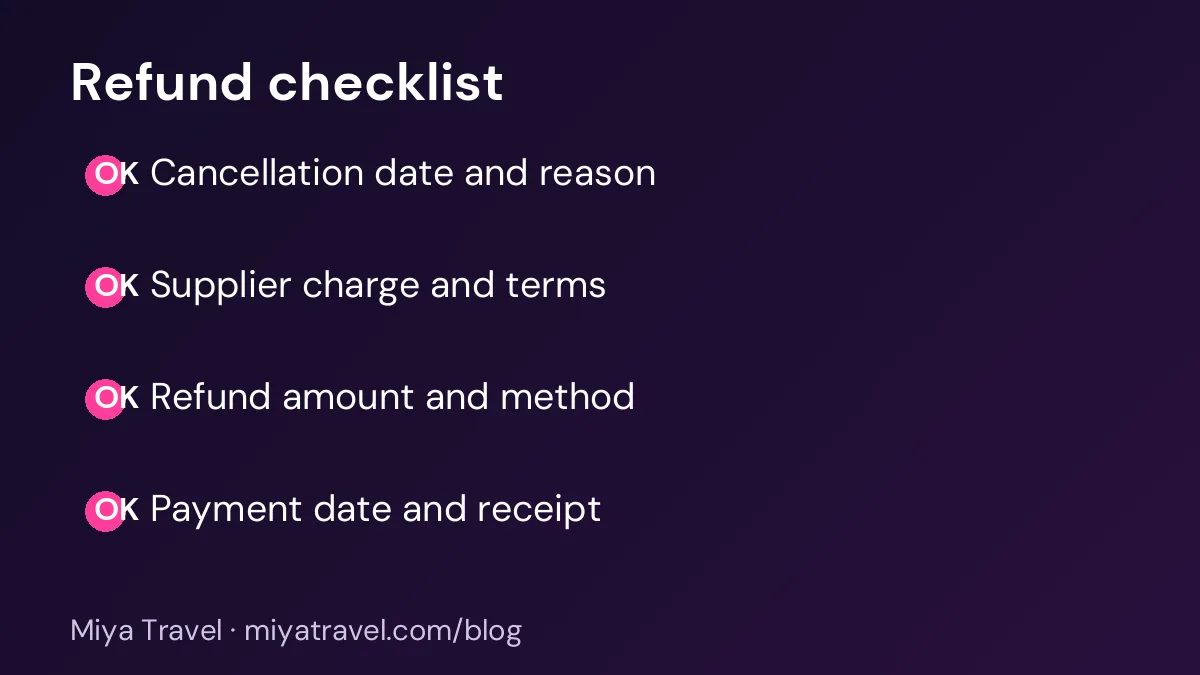
Each cancellation should have one record. Include the booking reference, the client name, the date the cancellation was requested, the reason, the trip dates and the amount paid so far. Record the reason even if it is simple, such as illness or a change of plans. Patterns in reasons help you improve the product and the policy.
Avoid handling cancellations by phone without a written record. A short written confirmation of the cancellation, sent to the client, protects both sides and starts the refund process clearly.
Calculate the supplier charge
Before you calculate the client refund, find out what the suppliers will charge. Check each supplier's cancellation terms for the booking. A hotel may charge a percentage of the room cost, a transport operator may charge a fixed fee and a guide may charge for short notice.
Record each supplier charge against the booking. Some suppliers will refund fully if you cancel early enough, while others will not refund at all. Know these rules before you promise the client a figure.
Calculate the client refund
The client refund is the amount paid by the client, minus the agency's cancellation charge and any supplier charges that the client must bear under the policy. Write out the calculation in the record, so the figure can be checked later.
For example, if the client paid a total of a certain amount, and the cancellation falls within a charge period, the agency keeps the agreed percentage and passes on any supplier charge that applies. The remainder is the refund. Show this calculation to the client in a short message, so they understand how the figure was reached.
Pay refunds promptly and in writing
Once the refund is agreed, pay it promptly and in the method the client paid with, where possible. Record the payment date, the amount and the reference number. Send the client a receipt or a short confirmation.
Delays in refunds cause the most frustration. If the refund will take longer than expected, tell the client early and explain why. A clear timeline reduces complaints.
Handle partial cancellations
Not every cancellation cancels the whole trip. A family may drop one passenger or a couple may shorten a stay. Each partial cancellation needs its own calculation, based on the items that are cancelled and the supplier charges for those items. Keep the original booking and the change record linked, so the total stays accurate.
Partial cancellations are where mistakes are most common. Check each item carefully, especially shared costs such as a group transfer or a shared room, which may not be easy to split.
Watch for disputes
Most refund disputes come from unclear policies or from promises made by phone. A client who was told one figure on a call and sees another figure in the refund will feel misled. Keep the figures consistent across calls, messages and the written calculation.
When a dispute arises, check the policy the client accepted, the calculation in the record and any messages sent. If the client has a valid point, offer a fair solution quickly. If the policy applies, explain it calmly and show the calculation.
Keep refunds in the books
Every refund should appear in the accounts, linked to the booking. A refund that is paid but not recorded can create a false profit figure. A refund recorded against the wrong booking can distort the ledger.
Share the refund report with the accountant each month. The report should list each cancellation, the supplier charge, the client refund and the net effect on revenue. This keeps the books accurate and supports tax filing.
Common mistakes
The first mistake is no written policy, so every cancellation becomes a negotiation. The second is promising a refund figure before checking the supplier terms. The third is no record of the reason, which hides patterns. The fourth is a delayed refund with no explanation. The fifth is a refund not recorded in the accounts.
Another mistake is treating every cancellation the same. The policy should allow for emergencies, such as illness, but the agency should document the reason so the decision is fair and consistent.
Choosing a system for refund tracking
Look for a tool that links each cancellation to the booking, calculates or records the supplier charge, stores the client refund and shows the payment. Ask the vendor to show a cancellation with a supplier charge and a partial refund, and check how the record appears.
If you use a spreadsheet, create one tab for cancellations with columns for the booking reference, date, reason, supplier charge, client refund, payment date and receipt number.
Our payment tracking guide explains how to record money going back to clients. Miya Travel focuses on the sales side of the agency, so check the documentation before you assume a specific refund feature exists.
Refunds for services not used during the trip
Sometimes a client does not use part of a trip after it has started. A traveller may leave early because of illness, or may skip an included excursion. These no-show or early-departure cases need a fair process. Check the terms in the booking, and find out whether the supplier will refund any unused service. Many hotels and tour operators do not refund services that were booked but not used, so the agency may not recover the cost.
Decide the policy in advance and state it clearly in the quotation. For example, the policy might say that unused services are not refundable, unless the supplier refunds them. Explain this to the client before the trip starts, not after. A client who learns the policy at the end of the trip will feel the decision is unfair, even when it is correct.
When a refund is due for an unused service, record the supplier's response, the amount they refund and the date. Pass on the refund to the client, after deducting any agency charge that the policy allows. Keep a copy of the supplier's written response with the booking.
Protecting the agency from fraudulent refund requests
Not every refund request is genuine. A client may claim a service was not provided when it was, or may request a refund for a trip that never took place. Check the claim against the booking records, the supplier confirmations and any evidence provided, such as photographs or receipts. A clear record protects the agency and the honest clients who are treated fairly.
Set a rule that refunds are paid only after the check is complete, and that the owner approves any refund above a set amount. This simple control prevents mistakes and makes the process consistent for every client.
Frequently asked questions
What should a travel refund policy include?
The cancellation charges by period, the treatment of non-refundable items, the refund timeline and the payment method. Keep it in plain words and share it at the start.
How do I calculate a refund?
Subtract the agency's cancellation charge and any supplier charge that applies from the amount paid by the client. Show the calculation in writing.
Should refunds be paid in the same method as the payment?
Where possible, yes. This makes the refund easy to trace and reduces disputes.
How do I handle a partial cancellation?
Calculate the refund for each cancelled item separately, based on the supplier charges for those items, and keep the original booking and the change record linked.
How long should a refund take?
Pay as soon as the refund is agreed. If it will take longer than expected, tell the client early and explain the timeline.